';
Authors Posts by Carol Ferenz

Carol Ferenz

1406 POSTS 0 COMMENTS

Message from the Department of Human Services (DHS):

Harrisburg, PA — Department of Labor & Industry (L&I) Secretary Jennifer Berrier and Department of Human Services (DHS) Acting Secretary Meg Snead today announced the Wolf Administration’s goal of using a $14 million federal grant to help Pennsylvanians with disabilities earning subminimum wage transition to competitive, integrated employment.

“Individuals with disabilities contribute their valuable skills, talents, time, energy and perspectives to Pennsylvania’s dynamic economy every day in professions and industries as diverse as our population. They deserve the same protections as all other workers, including the right to earn at least minimum wage for their work,” Secretary Berrier said. “The Wolf Administration will use this funding to help individuals with disabilities and their families learn about and take advantage of opportunities in competitive, integrated employment. There can and should be a role for everyone who wants to and is able to work, and we are grateful to those employers who have already committed to providing competitive, integrated employment.”

Pennsylvania is one of 14 states to receive grant awards from the federal Department of Education for the Subminimum Wage to Competitive Integrated Employment (SWTCIE) demonstration project. L&I’s Office of Vocational Rehabilitation (OVR) and DHS’s Office of Developmental Programs (ODP) will use the funding to develop a five-year plan to support Pennsylvanians with disabilities in transitioning out of subminimum-wage employment — including more than 5,400 people who currently work in “sheltered workshops,” most of whom have intellectual disabilities or autism — as well as students and youth with disabilities seeking to enter competitive, integrated employment (CIE).

“There can be an end to the subminimum wage exception for individuals with disabilities, but it is incumbent on all of us to make that happen. Workplaces should examine their policies to see which ones are outdated or intentionally or unintentionally discriminating against individuals with disabilities,” said Acting Secretary Snead. “Pennsylvanians with intellectual disabilities and autism are vital members of our society and of our workforces, and DHS is proud to support opportunities to help them find gainful competitive integrated employment. We are grateful to the federal government for this grant so we can continue this work.”

The practice of paying individuals with disabilities subminimum wage is legal under Section 14(c) of the Fair Labor Standards Act of 1938, a federal law. In September 2020, the U.S. Commission on Civil Rights called for an end to subminimum wage in a report, saying that the program has been “inconsistent with the civil rights protections to which people with disabilities are entitled.” To date, several states have, or are in the process of, ending subminimum wage for people with disabilities or are in the process of phasing it out.

The federal grant will fund Pennsylvania’s Integrated Vocational Engagement and Supports Team (InVEST) Project, a wraparound model for assisting individuals with disabilities — including those considering or currently engaged in employment at subminimum wage — their families and employers, to move from subminimum wage employment to competitive, integrated employment.

The project aligns with the commonwealth’s Employment First philosophical approach that CIE be the first and preferred option and will enhance the commonwealth’s existing network of community rehabilitation service providers by allocating additional resources for staff who will work directly with CIE employers proactively engaged in supporting employees with disabilities and creating a culture of accommodation for all employees. These employer liaisons and employment specialists will be embedded with CIE employers to support employees with disabilities, facilitate communication, create a smooth hiring process, and provide on-the-job supports to ensure success. An interdisciplinary and collaborative resource team will anticipate and respond to the SWTCIE participants’ employment-related needs.

The Wolf Administration encourages all employers to consider learning more about this topic and becoming involved in Employment First, which requires any group receiving public funding to ensure that employment is the main focus for education, training, or support services for anyone with a disability who is eligible to work. Employers can explore opportunities to enhance their workforce by hiring people with disabilities who are invaluable members of our communities, workforce, and economy.

a memo is on the keyboard of a computer as a reminder: meeting

As a reminder, the SCO Subcommittee will meet next Thursday, October 6, 2022, from 9:15 am – 12:00 pm. We are honored to have Deputy Secretary Kristin Ahrens and Lauren House from the Office of Developmental Programs (ODP) joining us at this meeting. We hope to have an interactive discussion on the role of Supports Coordination Organizations in the ODP system.

If you haven’t already registered, please do so here. If you have any questions, please contact Carol Ferenz.

In February 2022, the Wolf Administration created the Abuse/Neglect Registry Taskforce to address a gap in protection created by having no systematic method for tracking perpetrators of abuse or neglect of adults with disabilities in the commonwealth.

Agencies that provide services to adults with disabilities currently do not have access to information related to substantiated abuse or neglect cases in which a prospective employee was the perpetrator. Adults with disabilities, including older Pennsylvanians, may experience avoidable harm when perpetrators of abuse and neglect are able to move from job to job without detection.

The Abuse/Neglect Registry Taskforce assembled and began meeting in March 2022. The Taskforce is comprised of a membership including: adults with disabilities; family members; protective services experts; Departments of Human Services, Health, Aging, and Education counsel, program, and protective services staff; provider association representatives; advocacy organization representatives; and the four Executive Directors from the Human Services Committees in the General Assembly.

The Taskforce was given the following objectives: outline desirable parameters for a registry, identify challenges for implementation, and provide recommendations for the adoption and implementation of an Abuse/Neglect Registry in Pennsylvania.

After several months of work on this project, the Taskforce has developed a draft proposal for the parameters of an Abuse/Neglect Registry for Pennsylvania. This draft is now being shared with the public for review and comment.

RCPA invites you to participate in a meeting to discuss the proposal and develop comments for the Taskforce to review. We will be meeting on Monday, October 17, 2022, from 1:00 pm – 2:00 pm. Please register here to attend this meeting. We also invite you to submit any comments to Carol Ferenz by close of business on October 17, 2022. Comments are due by the end of the day on October 18, 2022.

The National Alliance for Direct Support Professionals (NADSP) shared this report:
Direct Support Workforce and COVID-19 National Report: 12-Month Follow-up

READ REPORT

While vaccination rates have improved among professionals supporting people with intellectual and developmental disabilities since the early days of the COVID-19 pandemic, their mental and physical health have declined, a new survey shows.

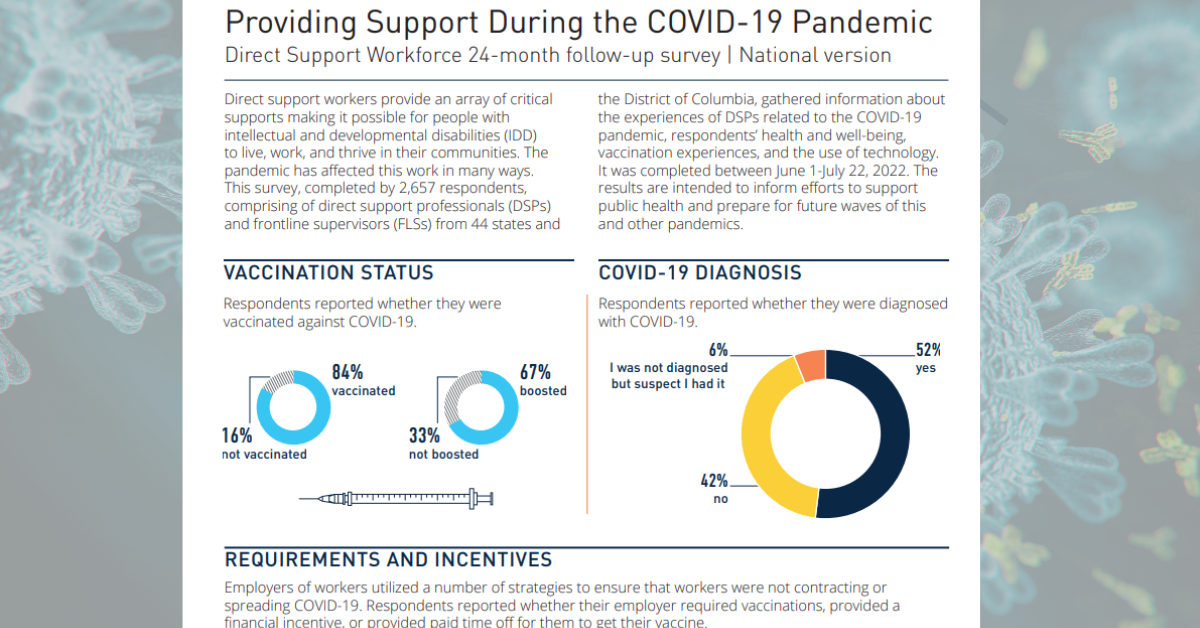
The Institute on Community Integration, in partnership with the National Alliance for Direct Support Professionals (NADSP), surveyed 2,657 DSPs and frontline supervisors about their experiences supporting people with IDD during the pandemic. The newly released survey report is a 24-month follow-up to an initial report issued in April 2020. Additional surveys were conducted six and twelve months after the initial report. The survey series represents the largest-ever national study of the DSP workforce.

According to the report, 52% percent of DSPs reported being diagnosed with COVID-19, and 6% were not diagnosed but suspected they had it. Among employers, 65% did not require DSPs to be vaccinated.

Sixteen percent of DSPs remain unvaccinated. Of the 84% who are vaccinated, 67% reported having at least one booster shot.

While vaccination rates have improved from the 12-month survey in 2021 (from 72% to 86%), the mental wellbeing of DSPs has declined. Forty percent of DSPs reported experiencing depression, compared with 36% one year ago; 43% had difficulty sleeping, a 13% increase; and 56% reported increased anxiety, a 14% increase. Fifty-nine percent of respondents said they felt pressure to work extra hours.

“Direct support professionals and frontline supervisors have worked as hard as they can,” said Amy Hewitt, ICI director and lead investigator of the study. “This survey shows that their mental health is worsening, and we don’t have the resources to address it. Working this much overtime is not sustainable.”

A national plan to increase the size of the direct support workforce would help to alleviate multiple troubling issues, Hewitt said.

“This workforce has been overlooked and in crisis for years, with high turnover and vacancy rates, low wages, and lack of access to affordable benefits,” she said.

More than half of DSPs receive government-funded assistance, such as housing, energy, food, and healthcare. The pandemic made staffing even more difficult, increasing stress, expectations, and risk on those who remain in their positions.

The 24-month follow-up survey also looked at changes in technology use during the pandemic. Fifty-nine percent of DSPs reported using technology more or a lot more than before the pandemic. Thirty-six percent of the respondents said the use of technology had a somewhat positive impact on their work, and 14% reported it had a very positive impact. Seventeen percent reported a somewhat negative impact and 3% a very negative impact.

Read the full report, a short version, and select state-specific versions here.

Please contact Jerry Smith with questions.

Image by Gino Crescoli from Pixabay

A reminder to providers who received Provider Relief Fund (PRF) payments during the period January 1, 2021, to June 30, 2021. You must use the PRF Reporting Portal to document the use of these funds by this Friday, September 30, 2022.

According to the HRSA website, “Recipients who do not report within the respective reporting time period will be considered out of compliance with payment Terms and Conditions, and funds may be subject to recoupment.”

If you have any questions, please contact your RCPA Policy Director.

Facilitating a Seamless Transition to Adulthood: Practical Information You Can Use Right Now! 

Part 1 Date: September 29, 2022, 1:00 pm – 2:30 pm ET

Part 2 Date: October 17, 2022, 1:00 pm – 2:30 pm ET

Part 3 Date: November 10, 2022, 1:00 pm – 2:30 pm ET

There is a job for everyone who wants one, regardless of disability, need for support, or economic vitality of their community. The culmination of public education for all youth with disabilities should be productive and meaningful careers — not just for some youth, or most youth, but all youth.

This 3-part webinar series will highlight key strategies to establish interagency teams, clarify roles and responsibilities, improve engagement of families and employers, and facilitate individualized work experiences in the community.

Special educators and administrators, Vocational Rehabilitation counselors, employment specialists, advocates and families are encouraged to attend to learn how to apply the tenants of seamless transition and promote successful futures for people with disabilities. Participants will receive access a set of tools essential to effective implementation of meaningful work experiences.

REGISTER FOR WEBINAR

Seeking CEUs?

Are you a Certified Rehabilitation Counselor or Certified Employment Support Professional seeking CEUs to renew your certification?
Then look no further! Our webinars closely align with both CESP and CRCC continuing education requirements.
Certificate of Completion for CEU self-submission is available through TransCen Online! 

Registration is now open for Home is the Heart of Shared Living: An International Gathering. The Gathering will take place virtually via Zoom on November 3 and 4, 2022. Visit New York Alliance for Inclusion & Innovation’s website to register as well as view the agenda and session offerings. It is a great line-up of presenters from near and far!