











';
Diversity

0 5164

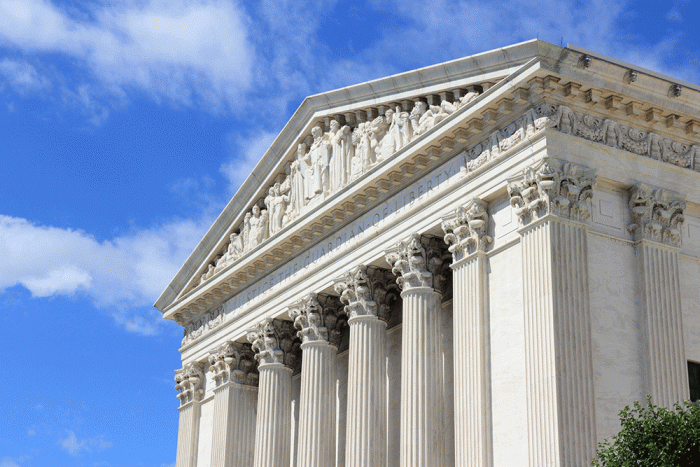
On March 31, 2026, the U.S. Supreme Court ruled 8–1 against a Colorado law that prohibited licensed mental health professionals from providing “conversion therapy” to minors. The case, Chiles v. Salazar, centered on whether the state could restrict certain counseling conversations aimed at changing a minor’s sexual orientation or gender identity.

Key points of the decision:

  • The Court held that Colorado’s law violated the First Amendment, concluding it restricted counselors’ speech based on viewpoint.
  • The majority, written by Justice Neil Gorsuch, said the statute regulated what therapists could say, which triggered strict constitutional scrutiny.
  • The Court determined the state’s attempt to frame the ban as regulation of professional conduct was insufficient because the therapy involved speech rather than physical treatment.
  • Justice Ketanji Brown Jackson issued the lone dissent, arguing states should be able to regulate harmful healthcare practices and protect minors.

The ruling may affect similar bans in more than 20 other states, putting them at risk of legal challenges. Supporters say the decision protects free speech and religious expression in counseling. Critics, including medical and LGBTQ+ advocacy groups, warn that it could weaken protections for youth from practices widely considered harmful.

View Pennsylvania’s stance on conversion therapy.

Talking About Sexuality: A Workshop for Parents of Youth and Adults with Intellectual and Developmental Disabilities
Session 1: Wednesday, February 11, 6:00 pm – 8:00 pm

Session 2: Monday, May 11, 6:00 pm – 8:00 pm
Register Here

Talking about sexuality with your loved ones with disabilities can be difficult. As parents and family members, we often worry whether they can be safe from harm in relationships. This workshop from Elevatus Training, LLC will help you become more comfortable and prepared for these conversations. Topics include:

  • What is Sexual Health?
  • Barriers to Communicating
  • Human Sexual Development
  • Tips for Talking

This training is free, provided virtually, and features small and large group discussions. Registration is required.

Sessions are capped at 40 participants. Automatic closed captioning and image descriptions will be provided. Contact Temple University via email to request additional access needs or questions.

This workshop is hosted and facilitated by the Healthy Sexuality Project at the Institute on Disabilities. This workshop is written and designed by Elevatus Training, LLC. The Healthy Sexuality Project is a program of the Institute on Disabilities at Temple University.

Bringing America Greatness — Serving the Disability Community With Cultural Competency/Do No Harm
February 19, 2026
10:00 am – 1:00 pm
Register Here

Session Description:

Cultural Competency is necessary for every American, regardless of age, race, religion, gender or sexual orientation, economic status, disability, or handicap. Being different does not guarantee the ability to relate positively to our diversity, in a personal or professional way. This training will help develop skills that focus on living-working-playing-learning together. These skills must be practiced and learned across all sectors of our society. Emphasis will be placed on equity as a right for all Americans embraced by leaders of people everywhere from birth to adulthood. Thus, cultural competency as a skill set is both beyond but essential to diversity and inclusion efforts, providing a chemistry for “greatness” in America.

The session is free, but registration is required, and attendance is on a first-come, first-served basis.

Please review the flyer for additional details.

The session will be offered virtually via the Zoom platform. The Zoom link for joining the session will be sent to the email you used to register. This link will be unique to your registration. Please do not share this link.

Send questions on registration electronically.

On January 28, 2025, President Trump issued Executive Order 14187 (Protecting Children from Chemical and Surgical Mutilation), directing federal agencies to cut off federal funding and support for gender-affirming care for people under age 19, including puberty blockers, hormone therapy, and gender-affirming surgery.

On December 18, 2025, health officials from the Trump administration announced several additional policy changes that, if finalized, will have the effect of essentially banning gender-affirming care for transgender young people, even in states where it remains legal.

One rule would prohibit Medicaid from covering any medical care provided to transgender patients younger than age 18 and prohibit reimbursement though CHIP (Children’s Health Insurance Program) for gender-affirming care for patients under 19.

Additionally, all Medicare and Medicaid funding would be blocked for any services at hospitals that provide pediatric gender-affirming care. This means that hospitals and doctors that perform gender-affirming care on minors will have to forgo federal Medicare and Medicaid funding under the new proposed rules. Virtually every hospital in the country relies on this funding, so the rule would have a wide-ranging impact and could likely make gender-affirming care inaccessible nationwide.

The proposed rules would exclude gender dysphoria not caused by physical impairment from civil-rights health care protections, reducing legal safeguards against discrimination in medical care.

This multi-pronged plan from DHS is part of the Trump Administration’s efforts to limit gender-affirming care, and if finalized, could have a profound impact on care delivery for transgender and gender non-conforming individuals.

On November 13, 2025, President Trump signed the executive order “Fostering the Future for American Children and Families,” an initiative to be led by the Office of the First Lady. The order is aimed at supporting children transitioning out of foster care into adulthood by modernizing the out-of-date child welfare system.

The Secretary of Health and Human Services must take the appropriate actions for the following within the next 180 days:

  • Update regulations, policies, and practices to improve data collection;
  • Promote modernization of child welfare information systems;
  • Expand States’ use of technological solutions; and
  • Publish an annual scorecard to measure and evaluate State-level achievement.

The HHS Secretary, in coordination with the First Lady and heads of other applicable offices, are to establish a “Fostering the Future” initiative to develop partnerships with agencies, private sector organizations, academic institutions, and non-profit entities to aid in the transition out of the foster care system. The order also calls for the development of an online platform to assist in the navigation of the transition, and an increase in the role of Education and Training Vouchers and educational scholarships. This initiative will be funded by the reallocation of funds returned by the States from Federal programs designed to assist in the transition out of foster care, but further details have not been clarified.

The final section of the Executive Order outlines the role of HHS in coordination with the Director of the White House Office of Faith and the White House Office of Intergovernmental Affairs, to:

“(a) take appropriate action to address State and local policies and practices that inappropriately prohibit participation in federally-funded child-welfare programs by qualified individuals or organizations based upon their sincerely held religious beliefs or moral convictions; and (b) take appropriate actions to increase partnerships between agencies and faith-based organizations and houses of worship to serve families whose children have been placed in foster care or are at risk of being placed in foster care.”

This order explicitly encourages partnerships with faith-based organizations and removes barriers for faith-motivated foster/adoptive families. While faith-based groups currently play a significant role in the foster care system, this order increases ethical tensions regarding what safeguards exist to protect foster youth who come from non-religious or different religious/cultural backgrounds from pressure to conform.

Further concerns with this order lay with language regarding “biological truths.” This term implies that LGBTQIA+, non-binary, or gender non-conforming individuals somehow conflict with science and is used to delegitimize trans and nonbinary identities. There is concern that partnerships with faith-based and other community organizations may not align with youth’s identities, especially older youth in the LGBTQIA+ community. Further guidance will be needed to ensure that any partnerships with faith-based organizations must be voluntary and respectful of each youth’s identity.

Additional concerns arise regarding equity of family selection and pairing/matching systems. Preferential selection of faith-based foster/adoptive families may lead to “religious filtering.” Potential foster/adoptive parents may be selected not on their capacity to care or their qualifications, but on religious affiliation or ideological alignment — which could lead to unfair exclusion of qualified non-religious or differently religious households. Upcoming policy changes could undermine equity and non-discrimination in the foster care system.

RCPA will keep abreast of developments on this issue and further guidance for agencies and individuals involved in the foster care system.

Please contact Emma Sharp with any questions.

0 1266

Evolving Legal Considerations of DEI: What Employers Need to Know
Thursday, November 20, 2025
12:00 pm – 12:30 pm
Register Here

About this event:
As the legal and political landscape continues to shift, employers are facing new pressure to balance inclusion goals with compliance requirements.

In this 30-minute live session, attorneys from Diversity Resources’ partner firm Epstein Becker Green will unpack what is changing, what remains protected, and how organizations can move forward with confidence.

You will gain from this webinar:

  • A clearer understanding of executive orders and their impact on employers;
  • Practical steps to stay compliant while maintaining inclusive practices; and
  • Guidance on how to navigate growing uncertainty around DEI initiatives.

This session will not be recorded to allow for open, candid discussion.