








Home Featured
Featured posts

Greenspace Health to Host “Transforming Behavioral Health Systems Through MBC” Webinar on April 25

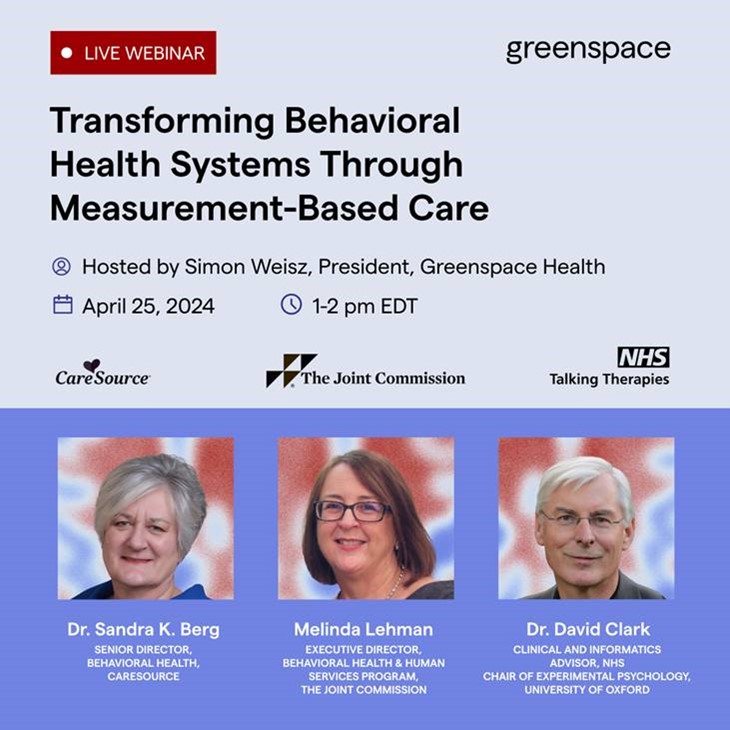 Transforming Behavioral Health Systems Through Measurement-Based Care
April 25, 2024 at 1:00 pm EDT
Visit here to register!
Greenspace Health has announced a highly requested and anticipated educational Measurement-Based Care (MBC) panel, featuring three key leaders driving behavioral health transformation from within a leading accreditation body, across a national system, and within a managed care organization.
As MBC adoption spreads rapidly within clinics, hospitals, large organizations, health systems, and national accrediting bodies like the Joint Commission recognizing it as a foundational component of any high-quality and evidence-based behavioral health service, there is a need for industry education surrounding large-scale and system-level implementations.
Hosted by Greenspace President and Co-Founder Simon Weisz, the panel will feature Melinda Lehman, Executive Director of Behavioral Health & Human Services at the Joint Commission; world-renowned applied psychologist and leading global expert on MBC Dr. David Clark; and Dr. Sandra Berg, Senior Director of Complex Health Solutions, Behavioral Health at CareSource. The panelists will dive deep on MBC, its relationship to value-based care, and share insights to inform any implementation.
Institute on Disabilities Releases IM4Q Statewide Report for FY 2022/23

The Institute on Disabilities has released its Statewide Report, which includes data gathered through the Independent Monitoring for Quality (IM4Q) Project in Pennsylvania during the 2022/23 fiscal year. Following the COVID-19 pandemic, data collection has shifted to a hybrid model, with some interviews taking place in person and others occurring remotely. Questions may be sent via email.
Italian Down Syndrome Organization “CoorDown” Creates #AssumeICan Ad for World Down Syndrome Awareness Day

An Italian Down Syndrome organization called CoorDown has released an ad in recognition of World Down Syndrome Awareness Day, which is held on March 21. Its tagline, #AssumeICan, is being used by people with Down Syndrome to show that many of the assumptions about their drive and abilities are just that…assumptions.
Negative assumptions are extremely limiting. Instead of assuming limitations, Madison Tevlin, a young woman with Down Syndrome, offers a suggestion: #AssumeThatICan.
You can watch the inspiring ad here. Please note that the ad contains strong language and some mature themes.
Reminder for ODP Annual Submittal of Financial Statements

The Office of Developmental Programs (ODP) reminds Residential Providers and Supports Coordination Organizations (SCOs)* of the new requirement to submit year-end financial statements no later than 9 months after their fiscal year end. For many providers this will be March 31, 2024. Details of this requirement are available in ODPANN 23-76.
If your MPI is included on the available spreadsheet, your financials have not been received as of March 25, 2024, and will need to be submitted.
ODP Provides Medication Administration Initial Summary and Remediation Requirements
The Office of Developmental Programs (ODP) has shared ODPANN 24-033. This announcement’s purpose is:
- To provide clarification on the Medication Administration Annual Practicum: Student Qualification Remediation;
- To provide clarification on the Practicum Observer (PO) Remediation Requirements for requalification;
- To provide clarification on the Medication Administration Initial Summary and Qualification Remediation;
- To announce that “enemas” have been added to the Non-Oral Medication Administration Guidelines for the routes that need to be trained by Health Care Professionals;
- To clarify Medication Administration System Housekeeping and serve a reminder that each trainer and student should only have one account;
- To provide instruction to trainers on grading the Trainer Attestation grade in the Online Student courses that went into effect on March 1, 2024; and
- To provide instruction to Trainers on grading Medication Administration Observation Checks in the Online Student courses.
Please view the announcement for additional information and details.
CMS Releases IRF PPS Proposed Rule for FY 2025
The Centers for Medicare and Medicaid Services (CMS) has released the fiscal year (FY) 2025 inpatient rehabilitation facility prospective payment system (IRF PPS) proposed rule. The proposed rule will be published in the March 29, 2024, Federal Register. A high-level overview of the proposed rule is provided below:
Payment Updates:
CMS estimates an overall increase in aggregate payments to IRFs by 2.5% or $255 million (compared to the 4% payment update in FY 2024).
Market basket update for IRF services is 3.2%. This will be reduced by a productivity adjustment of 0.4%, which would result in an overall 2.8% increase. These figures are likely to change due to updated forecasts.
CMS is proposing to update the outlier threshold amount from $10,423 (FY 2024) to $12,158 (FY 2025), which would account for an estimated 0.2 percent decrease to aggregate payments across the IRF PPS in FY 2025.
Quality Reporting Program (QRP) Updates:
CMS is proposing to make additions, modifications, and removals of some QRP measures. A proposal was included to collect four new Standardized Patient Assessment Data Elements (SPADE) in the IRF QRP to bolster the collection of information on social determinants of health (SDOH):
- Living Situation: Requests regarding the current living situation;
- 2 Food Items: Questions about food running out;
- Utilities: Questions about threats to shutting off utilities; and
- A modification to an existing SPADE on Transportation.
CMS is also proposing to remove the “Admission Class” from the IRF Patient Assessment Instrument (PAI).
Feedback is requested on future revisions to the IRF QRP, as well as feedback on the development of a five-star methodology for IRFs.
Additional information will be forthcoming. Comments on the proposed rule are due to CMS by the end of May.
OCYF Launches Pennsylvania Meaningful Family Engagement Toolkit

The Department of Human Services Office of Children, Youth, and Families (OCYF) has launched the Pennsylvania Meaningful Family Engagement Toolkit, a web-based resource developed through statewide quality improvement efforts. Over a two-year collaboration period, Pennsylvania system partners defined meaningful family engagement, set consistent expectations for day-to-day practice, and prioritized organizational cultures supporting family engagement. The toolkit provides a comprehensive definition of meaningful family engagement and offers specific strategies and skill-building opportunities for child welfare professionals to enhance engagement and improve outcomes. It also highlights populations needing additional support for engagement, which they have included as fathers, youth, out-of-state parents, incarcerated parents, and extended family. Child welfare professionals are encouraged to utilize this resource to ensure consistent and sincere practice of meaningful family engagement.
If you have any questions, please contact RCPA Policy Director Jim Sharp.
ANCOR Announces Publication of Sample Shared Living Contract
Project ECHO Announces “Project Reassure” Training Program on April 5

 Prev
Prev