







SAMHSA Awards RCPA Member Merakey $2M for Pilot Program to Expand Certified Community BH Clinic Services


The Pennsylvania Department of Drug and Alcohol Programs (DDAP) has released its Compulsive and Problem Gambling Annual Report, highlighting prevention and treatment efforts for state fiscal year (SFY) 2024/25.
This year’s report reflects continued progress in connecting Pennsylvanians to help and expanding prevention outreach across the Commonwealth.
Highlights include:

The Office of Developmental Programs (ODP) has finalized the new quarterly Supports Coordination Organization’s (SCO) Performance-Based Contracting (PBC) Measures data reports, which will be available in DocuShare no later than October 10, 2025.
Updated reporting includes:
ODP will send a follow-up notification once the reports are posted. Please ensure that designated staff within your organization have access to DocuShare and are prepared to retrieve and review these reports.
Please contact your ODP Regional Office with any questions.

November 19, 2025
9:00 am – 4:00 pm
Register Here
Understanding Neuroplasticity and Recent Advancements in Enhancing Supports
The Office of Mental Health and Substance Abuse Services (OMHSAS) and the Office of Developmental Programs (ODP) invite you to register for the 2025 Dual Diagnosis Conference to be hosted virtually on November 19. Join us for this one-day virtual conference to gain a better understanding of neuroplasticity and recent advancements in enhancing supports for individuals with intellectual disabilities. There is no cost to attend, but registration is required.
Speakers for the day include:
Dr. Ken Martz
Ken Martz, PsyD, MBA, is a licensed psychologist, bestselling author, and expert in emotional development. He has worked in the treatment and management of addiction for the past 30 years across settings including outpatient, residential, and hospital settings. He was formerly the Special Assistant to the Secretary for the Department of Drug and Alcohol Programs in the Commonwealth of Pennsylvania and Policy Director in Substance Use Disorders of the Governor’s Policy Office. Dr. Martz will start the day with an overview of neuroplasticity.
Dr. Brandi Kelly
Brandi Kelly, PhD, is the Clinical Director for Louisiana’s OCDD. She received her doctoral degree in clinical psychology from Louisiana State University in 1998 and a post-doctoral master’s degree in clinical psychopharmacology from Alliant University in 2002. She has worked extensively in community- and residential-based programs providing support planning, staff training, and behavioral health services to individuals with developmental disabilities, and she has published research on assessment and treatment of behavioral and mental health concerns of individuals with developmental disabilities. Dr. Kelly’s presentation will provide a clinical focus on how to use neuroplasticity data.
Dr. Calliope Holingue
Calliope Holingue, MPH, PhD, is a research faculty member at the Center for Autism Services, Science, and Innovation at the Kennedy Krieger Institute. A psychiatric epidemiologist by training, she has a joint academic appointment as an assistant professor at the Department of Mental Health at Johns Hopkins. Dr. Holingue will share current research and developments related to neuroplasticity.
The day will conclude with a Q&A session with all three of our speakers.

Novitas Solutions has released the Cycle 2 results for the inpatient rehabilitation facility (IRF) review choice demonstration (RCD). The Cycle 2 results letters were issued on September 10, 2025, and are available in Novitasphere.
IRFs will have a 2-week choice selection period for Cycle 3 from October 7, 2025 – October 20, 2025, using the Novitasphere portal.
Cycle 3 Choice Selection Options
If the approval rate meets or exceeds target affirmation rate of 85% for Cycle 2 (based on a minimum of 10 submitted pre-claim review requests or claims), the IRF may select 1 of the 3 subsequent review choices:
If the IRF’s affirmation or claim approval rate is less than the target affirmation rate or they have not submitted at least 10 requests/claims, the IRF must again choose from 1 of the initial 2 options:
Cycle Stats Reminder
IRFs can access information about their affirmation/approval rate at any given time during the current or previous review cycle through the Cycle Stats option in Novitasphere. Visit here for more information on cycle stats.
IRF RCD Questions
Questions or concerns regarding the IRF RCD should be directed to the IRF Customer Service line at 855-340-5975, Monday – Friday, 8:00 am – 6:00 pm.
IRF RCD Resources and Educational Opportunities
Visit the Inpatient Rehabilitation Facility (IRF) Review Choice Demonstration (RCD) web page for important information about the IRF RCD and upcoming educational events, including a recording of the September 24, 2025, webinar on IRF RCD: Cycle 2 Results and Transitioning to Cycle 3.
Important Deadlines

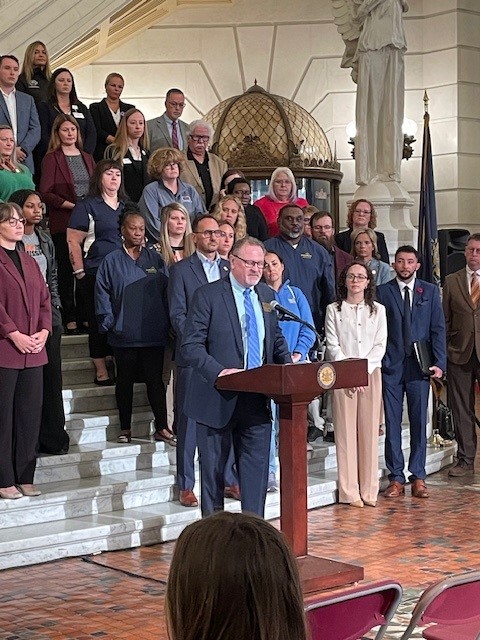
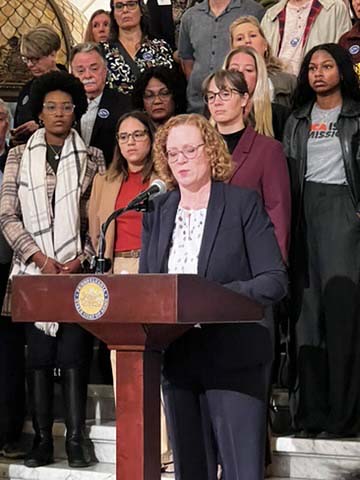
On Thursday, October 2, RCPA joined The Coalition of Critical Services Providers at the Harrisburg State Capitol Rotunda, urging Governor Shapiro and the Pennsylvania General Assembly to pass a final state budget that invests appropriately in health and human services before there are no providers left to care for Pennsylvania’s most vulnerable. The event served as a call for an immediate budget resolution to ensure vital services for residents can continue across the Commonwealth as the Pennsylvania budget impasse enters its fourth month. Speakers included RCPA COO and Mental Health Policy Director Jim Sharp and President from United Way of PA Kristen Rotz. Behavioral Health Division Policy Associate Emma Sharp and Government Affairs Director Jack Phillips were also in attendance.
 |
—– |  |
 |
—– |  |

In addition, RCPA member EIPA Vice President Anne Lang and RCPA member Pathways Forward CEO Pat Slattery spoke of the current challenges in funding, stressing that investing money now would be vastly more economical than the long-term cost of leaving services underfunded.
 |
—– |  |

Topic: Autism Spectrum Disorders (ASDs) — An Overview and Practical Application
Note: This training satisfies the basic autism training requirement for Residential Performance-Based Contracting (PBC). Please see more details below on Continuing Education (CE) Credits. This training is an approved alternative to the SPeCTRUM offered on MyODP.
Over the years, the prevalence of autism has increased, Pennsylvania’s service delivery system for individuals with autism has expanded, and best practices to provide quality supports have emerged. To support the individual needs of each person with autism across the lifespan, an understanding of core characteristics must be established. It is also important to learn how the individual’s presentation of autism may change across settings and situations. This training will provide attendees with an in-depth presentation on core characteristics of autism and the impact of the characteristics on daily life, routines, and activities. A review of common terms and basic principles used to change behavior, teach new skills, and develop practical application of best practices will be included. Opportunity for discussion and engagement will occur throughout the training in the virtual setting.
Who should attend?
Where and when will sessions be held?
You must register separately for each session.
Continuing Education Units (CEU):
This training satisfies the basic autism training requirement for Residential Performance-Based Contracting measures CN-DD/Bx.01.1S and CN-DD/Bx.01.1CE for all Direct Support Professionals (DSP), Frontline Supervisors (FLS), and program managers. This training also fulfills 6100 ongoing training requirements.
To receive a training certificate, attendees must attend both virtual sessions.
Please contact the Bureau of Supports for Autism and Special Populations (BSASP) Training inbox with questions.


The correct date for the November Long-Term Services and Supports (LTSS) Subcommittee meeting will be held Wednesday, November 12, 2025. Please disregard the previous communication sent on October 1, 2025. The meeting will be held as a webinar with remote streaming only, from 10:00 am – 1:00 pm.
If you need an American Sign Language (ASL) interpreter and/or another accommodation, including an alternative method for submitting questions or comments about meeting topics, please send an email no later than October 17, 2025, so an ASL interpreter or other accommodations can be scheduled.
Register here. After registering, you will receive a confirmation email containing information about joining the webinar.
Remote captioning and streaming services will be provided. If you require these services, please visit this remote captioning and streaming services link.
 Prev
Prev