


';
Govt. Affairs

0 3633

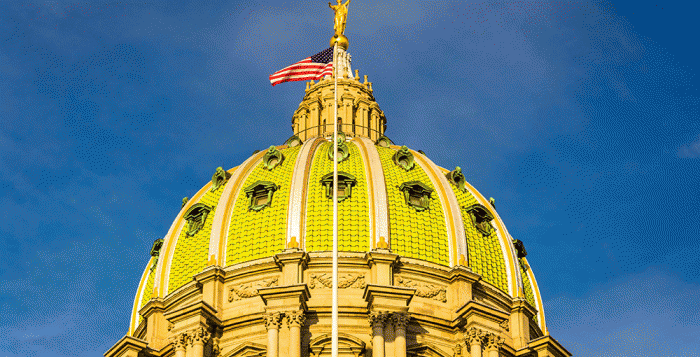
Governor Josh Shapiro delivered his 2025/26 budget address to a joint session of the General Assembly at the State Capitol in Harrisburg. The Governor’s $51B budget plan seeks more money for underfunded public schools and public transit in his budget proposal unveiled Tuesday, while he is also hoping to win support for legalizing marijuana and introducing taxes on skill games viewed as competitors to casinos and lottery contests.

A key factor is that the Pennsylvania revenue for the fiscal year has flattened out, and without the American Recovery Act surplus and the Rainy Day Fund, expenditures related to “cost to carry”; that is inflation, are not projected to be met. Once those sources are used, they are gone, but the legislature could decide to spend an additional billion or two of General Fund revenue on an infusion into the Rainy Day Fund. While the legalization of marijuana and regulation of skill games could address some of this, both sources have unpredictable revenue returns.

The Governor’s proposed budget priorities align with several of the RCPA strategies as outlined in the 2025 Legislative and Administrative Priorities.

What was not clear were the defined spending pathways or line item allocations. RCPA is hoping that the DHS Budget Address on Friday from Secretary Dr. Val Arkoosh will provide clarification on the human services budget. It should be noted that at this point, while we understand the governor’s priorities, details are not yet apparent. In fact, many of the areas related to RCPA members have more questions than answers and will evolve as the discussion continues between the administration and the legislature.

Behavioral Health
As an example, one area of concern is that the Medicaid Behavioral Health Capitation system experienced a shortfall of several hundred million dollars in the current fiscal year. There are significant dollars noted in the various spreadsheets related to the capitation, but again the detail is not there. In one document, it is noted that “In total, over $2.5 billion is needed to meet actuarially sound rates in the remainder of the 2024/2025 fiscal year and into the 2025/2026 budget year.” Is it solely to replenish lost dollars for the primary contractors? What is the breakdown between behavioral health and physical health? RCPA will be looking for more clarity.

Legalization of adult-use recreational marijuana is a priority for the governor, who is estimating more than $500M in revenue in 2025/26. None of that revenue is projected to be shared, however, with the Department of Drug and Alcohol Programs.

The proposed budget would also expand existing loan forgiveness initiatives, to incentivize more health care providers and behavioral health specialists to take jobs all across Pennsylvania.

Intellectual and Developmental Disabilities
Additionally, there is no apparent delineation of funding for IDD services, and while it has a line item placeholder indicating a $175M increase, it remains unclear if this is new or previously allocated funds from last year’s budget. Or simply the cost of maintaining current programs but not new individuals or services.

School-Based MH Funding
Governor Shapiro is again proposing Physical Security and Mental Health funding in the FY 2025/26 budget, proposing $100M in funding to school districts across the Commonwealth. This proposal is flat funding from FY 2024/25 and, if enacted, new investments in school safety and mental health will total approximately $350M in the governor’s term to date.

County Funding
$20M is proposed in continued additional investment for county mental health based services funding. This would represent a total new investment of $60M over three years. While this marks the third year of increased funding to the counties, it remains far short of the needed investment for these critical services. It has been reported that there is the need to invest nearly a billion dollars to level set the current county based mental health system.

Early Intervention
Early Intervention will see a proposed increase after a year of no rate adjustments. OCDEL did complete a rate methodology study in 2024, but it is unclear regarding the impacts of the study on the new proposed budget. The overall proposed funding for Early Intervention Part C represents an increase over FY 2024/25 of $16M (+3.5%), including $10M to provide a rate increase for early intervention providers in Part C, birth to age three programming.

Other DHS Related Human Services Funding Areas:

  • $10M in dedicated funding to support the 9-8-8 hotline network.
  • $5.75M to expand discharge and diversion programs for individuals with mental illness in the
  • criminal justice system.
  • $4.8M to provide reentrants with MA services and continuous eligibility after incarceration. This is a component of the recently approved Section 1115 CMS Waiver, Keystones of Health.
  • $5M to continue funding for walk-in mental health crisis stabilization centers supporting multiple counties.

DHS Budget Briefing Friday, February 7, 2025
Secretary Val Arkoosh and leadership from the Department of Human Services (DHS) will host a webinar to discuss the proposed 2025/26 budget for the department. The briefing will take place at 10:00 am on Friday, February 7. If you are unable to attend, the briefing will be recorded and available for viewing afterwards on DHS’ YouTube channel.

Use this link to register for the briefing. All who plan to attend must register individually. A link for the webinar will be sent Thursday evening. DHS encourages submission of questions ahead of the briefing so they can prepare as much information as possible. They will follow up on any questions that are not answered during the webinar.

(If the registration link above does not work, please try copying this link directly into your browser: https://forms.office.com/Pages/ResponsePage.aspx?id=QSiOQSgB1U2bbEf8Wpob3tuk6VNEbjZIvvnDA4XOB-dUNVlFUVRMQUVBMzhPWVpRNjNFODQ1OUlaTy4u)

RCPA will continue to update members as further details develop on the proposed budget, including information on specific policy areas. If you have additional questions, please contact your respective RCPA policy director.

Photo by René DeAnda on Unsplash

RCPA provided some late updates yesterday on the Federal funding freeze, and late last evening, the National Council for Mental Wellbeing provided members a legal interpretation on the rescinding of the Office of Management and Budget (OMB) M-25-13 and the issuance of the new memorandum M-25-14.

The following is from the National Council:

On Wednesday afternoon, the White House Office of Management and Budget issued a new memorandum—M-25-14 — that rescinded the pause to federal funding contemplated in a previous memorandum first issued on Monday night.

The new memorandum, which was directed to “heads of executive departments and agencies,” features a two-sentence statement reading: “OMB Memorandum M-25-13 is rescinded. If you have questions about implementing the President’s Executives Order, please contact your agency General Counsel.”

In the short term, M-25-14 certainly relieves some of the confusion and anxiety that swept across the federal grants world since Monday night. Our previous client alerts have chronicled the chaos that emerged late Monday and throughout the day on Tuesday.

However, in our review, there are still five key Executive Orders issued by the Trump Administration not affected by the rescission of M-25-13. Those EOs include:

While the upheaval following the issuance of M-25-13 may have prompted the Trump Administration to change course and move away from pausing all federal funding, we certainly anticipate that federal grants in the above-listed areas will remain subject to a comprehensive review and new standards. Federal grantees with programs in these specific areas should undertake a detailed review and be prepared for future agency actions.

Federal grantees should continue to keep apprised of the Administration’s actions, orders, and statements relating to federal funding — as the rescinded memorandum likely foretells future clashes as the Administration attempts to exert control over federal spending.

Chuck Ingoglia
President & CEO
Strategic Leadership
National Council for Mental Wellbeing


In addition, ANCOR sent the following information last night:

In what’s turning from a whirlwind couple of days into a whirlwind week, there were notable updates today on the OMB memo on the freeze of certain federal funding issued earlier in the week. 

Today OMB withdrew the memo with a simple rescission statement after a federal judge temporarily blocked the funding freeze for open awards and current spending. The order remains in effect until February 3 when a hearing is scheduled to determine next steps.  

As you may have seen, later in the day, Press Secretary Karoline Leavitt posted to X, “[t]his is NOT a rescission of the federal funding freeze. It is simply a rescission of the OMB memo. Why? To end any confusion created by the court’s injunction. The President’s EO’s on federal funding remain in full force and effect, and will be rigorously implemented.” Without further specificity regarding the implicated executive orders, the situation remains fluid with the potential for later memos or other interpretive guidance which the White House maintains is authority held within the executive branch.

In other litigation, U.S. District Judge Jack McConnell made statements in court today indicating that another restraining order may be coming. With the memo rescinded, the Department of Justice Special Counsel argued the case is no longer relevant. However, the judge did not appear persuaded and asked for a draft protective order for response and consideration. 

We’ll continue to keep you posted as we know more and hope to see you Friday (1/31) for our extended Members-Only Weekly Briefing at 12:30 pm ET to provide updates and review all available information together. See login information below:
Join Zoom Meeting: ancor-org.zoom.us/j/… 
Meeting ID: 870 2745 7284 
Passcode: 977618 


In recent communications from the OMB, these actions will not impact programs that provide direct benefits to individuals and are explicitly excluded from the pause and exempted from this review process. In addition to Social Security and Medicare, already explicitly excluded in the guidance, mandatory programs like Medicaid and SNAP will continue without pause.

RCPA will continue to communicate new developments with members as they emerge. If you have any questions, please contact your RCPA Policy Director.

0 1709

RCPA, in working with ANCOR and the National Council for Mental Wellbeing, has learned that the Office of Management and Budget (OMB) has rescinded the memorandum sent yesterday by the Trump Administration, which announced the pausing of distribution of federal funding.

Per National Council:
Moments ago, the Office of Management and Budget (OMB) reversed course on a memorandum instructing all agencies to temporarily pause the obligation and distribution funds for a wide swathe of federal programs, officially rescinding the order that spurred widespread confusion yesterday. The White House’s decision to rescind the memo comes after U.S. District Court Judge Loren AliKhan issued a brief temporary stay that would have delayed OMB’s directive from taking effect until Monday, Feb. 3, with the potential for further legal action beyond that date.

In addition, ANCOR reached out to members and said the following:

Hi everyone,

We wanted to make sure to update you that today OMB rescinded its memo from January 27 requiring a freeze on federal financial assistance: White House rescinds freeze on federal grants – The Washington Post. You can see the notice of rescission hereThank you to all of you who reached out and helped push back on this yesterday! We are so grateful for your advocacy.

Thanks,
Elise

——————————

Elise Aguilar
Senior Director of Federal Relations
American Network of Community Options and Resources
Alexandria, VA
703-535-7850

RCPA will continue to communicate with our members as developments occur or if changes are made. As a reminder, this will not affect funding services that directly impact individual Americans, including Medicaid, Medicare, Social Security, and SNAP. If you have any questions, please contact your RCPA Policy Director.

Image by David Mark from Pixabay

RCPA continues its efforts to update members on the White House funding freeze while partnering with the National Council for Mental Wellbeing and ANCOR in examining the implications stemming from the White House Office of Management and Budget’s (OMB) January 27 memorandum temporarily freezing federal disbursements to many federal programs.

The National Council has provided the following update:


Federal agencies have been directed to fill out a spreadsheet as part of an analysis by Feb. 7 to ensure compliance with the president’s most recent executive orders. This is a breakdown of which health programs are included in this latest action.

Notably, we recognize conflicting guidance has been issued. While the above report identifies Medicaid programs, a Q&A document from the administration notes that Medicaid will continue without pause. As of Tuesday morning, all 50 states reported outages of their Medicaid online portals, and the Trump administration has stated they are aware of the outages and expect the portals to be back online shortly.

Also, several groups have taken action to block this funding freeze. As of this writing, several Democratic state attorneys general said they would ask a court to block the freeze from taking effect. Several groups representing nonprofits, public health professionals and small businesses have already filed suit in D.C. asking the court to prevent the freeze from continuing. On Tuesday evening, U.S. District Court Judge Loren L. AliKhan issued a temporary stay on the funding freeze until Feb. 3 at 5:00 pm ET.

The funding freeze may lead to project delays or cancellations, resulting in layoffs of workers involved in these programs, and may ultimately increase the unemployment rate, making it vital lawmakers understand the impact of this freeze on communities across the country.


Most notable are the concerns with the intersects of Medicaid funding though the information that has been released. The Q&A document states:

Q: Is this a freeze on benefits to Americans like SNAP or student loans?

A: No, any program that provides direct benefits to Americans is explicitly excluded from the pause and exempted from this review process. In addition to Social Security and Medicare, already explicitly excluded in the guidance, mandatory programs like Medicaid and SNAP will continue without pause.

RCPA will continue to communicate new developments with members as they emerge. If you have any questions, please contact your RCPA Policy Director.

0 1605

The Rehabilitation and Community Providers Association Political Action Committee (RCPA PAC) is asking members to consider making a personal contribution to the PAC. With these donations, we have been successful in supporting legislative leadership who understand the severe challenges facing many of our providers. These representatives are willing to stand up for our issues as we fight to move Pennsylvania forward.

We urge you to view our 2025 Legislative & Administrative Priorities to see how RCPA is and will continue to work for you. We are able to achieve these goals thanks to our members’ dedication and contributions.

Make an online contribution and advocate for yourself today. While the request is voluntary, we encourage you to make a contribution of $100, $250, $350, $500, or more to the RCPA PAC. If you are interested, you can also consider making a recurring monthly donation.

If you have any questions regarding the RCPA PAC or making a donation, please contact Jack Phillips, Director, Government Affairs.
RCPA will be hosting our 2025 Capitol Day on Wednesday, March 26. We will hold a press conference/rally from 10:00 am – 11:00 am in the Capitol’s Main Rotunda. Members are requested to schedule appointments with their State Senate and House legislators to discuss the state budget, legislation, and regulations that affect the day-today activities of our members. For your convenience and use in legislative meetings, RCPA has developed a brochure highlighting our legislative and regulatory priorities. More information will follow, but if you have questions or suggestions regarding our 2025 Capitol Day, please contact Jack Phillips, Director of Government Affairs.

0 4905

This week, the Pennsylvania House and Senate held leadership elections for the upcoming 2025–26 legislative session. The biggest changes are within the House Republican Caucus. RCPA looks forward to working with the leaders in all four caucuses.

The results of the leadership elections are as follows:

Senate Republicans

  • President Pro Tempore Designee Kim Ward (Westmoreland)
  • Majority Leader Joe Pittman (Indiana)
  • Majority Whip Ryan Aument (Lancaster)
  • Majority Appropriations Chairman Scott Martin (Lancaster)
  • Majority Policy Chairman Dan Laughlin (Erie)
  • Majority Caucus Chairman Kristen Phillips-Hill (York)
  • Majority Caucus Secretary Camera Bartolotta (Beaver/Greene/Washington)
  • Majority Caucus Administrator Lisa Baker (Luzerne/Susquehanna/Pike/Wayne/Wyoming)

Senate Democrats

  • Minority Leader Jay Costa (Allegheny)
  • Minority Whip Tina Tartaglione (Philadelphia)
  • Minority Appropriations Chairman Vince Hughes (Philadelphia/Montgomery)
  • Minority Policy Chairman Nick Miller (Lehigh/Northampton)
  • Minority Caucus Chairman Maria Collett (Montgomery)
  • Minority Caucus Secretary Steve Santarsiero (Bucks)
  • Minority Caucus Administrator Judy Schwank (Berks)

House Democrats

  • Speaker Designee Joanna McClinton (Philadelphia)
  • Majority Leader Matt Bradford (Montgomery)
  • Majority Whip Mike Schlossberg (Lehigh)
  • Majority Appropriations Chairman Jordan Harris (Philadelphia)
  • Majority Policy Chairman Ryan Bizarro (Erie)
  • Majority Caucus Chairman Rob Matzie (Beaver)
  • Majority Caucus Secretary Tina Davis (Bucks)
  • Majority Caucus Administrator Leanne Krueger (Delaware)

House Republicans

  • Minority Leader Jesse Topper (Bedford)
  • Minority Whip Tim O’Neal (Washington)
  • Minority Appropriations Chairman Jim Struzzi (Indiana)
  • Minority Policy Chairman David Rowe (Union)
  • Minority Caucus Chairman Martina White (Philly)
  • Minority Caucus Secretary Clint Owlett (Tioga)
  • Minority Caucus Administrator Sheryl Delozier (Cumberland)

If you have any questions, please contact Jack Phillips.

Pennsylvania saw a large Election Day turnout in certain areas of the Commonwealth, so before sending out the Election Day update, RCPA wanted to wait so we could report to you the most accurate information available.

As of today, November 8, 2024, there are still two seats in question. One is the US Senate race between the Incumbent Sen. Bob Casey (D) and his opponent, Dave McCormick (R). The other seat in question is in Cambria County between Incumbent State Rep. Frank Burns (D) and his opponent, Amy Bradley (R).  More information on these two races is available below.

Election Results

President

Trump (R) – 50.5%
Harris (D) – 48.5%

Donald Trump won the race to be the 47th President of the United States. Trump saw increased support this election with Black and Latino men. The rural areas of the Commonwealth offset any Democrat leads in the urban areas, and in many urban areas Trump limited the Democrats’ winning margins.

US Senate

McCormick (R) – 49%
Casey (D) – 48.5%

This race has been called by the Associated Press (AP) in favor of Dave McCormick, but Sen. Casey has not conceded the race yet. According to AP, McCormick is currently winning by about 30,000 votes. AP believes the remaining votes will break in favor of McCormick. We will keep the members posted as events unfold.

The Republicans have flipped the US Senate and currently have a 52-seat majority, with the possibility of gaining two more seats (Pennsylvania and Arizona).

US House

The US House is projected to stay in Republican control by a 222–213 majority. In Pennsylvania, two  US House seats flipped from Democrat to Republican in Northeast PA and the Lehigh Valley (see results below).

District 7 (Lehigh Valley)
Ryan MacKenzie (R) – 50.7%
Incumbent Susan Wild (D) – 49.3%

District 8 (NEPA)
Rob Bresnahan (R) – 51%
Incumbent Matt Cartwright (D) – 49%

District 10 (Cumberland, Dauphin, Perry, York Counties)
Incumbent Scott Perry (R) – 50.8%
Janelle Stelson (D) – 49.2%

PA Senate

The Republicans went into Election Day with a 28–22 seat majority and came out of the election with the same majority.

PA House

The House Democrats went into Election Day with a majority of seats, 102–101. As of today, November 8, 2024, one race will decide whether the Democrats maintain control of the House or the Republicans assume majority control.

The race in question is in Cambria County, between Incumbent Democrat Frank Burns and his Republican opponent, Amy Bradley. As of today, Burns holds a 936 vote lead with approximately 97% of the vote in. As of this writing, the AP called the race for Rep. Burns, but challenges will probably be filed by the Bradley campaign.

Next Week

The House will be in session next Tuesday and Wednesday, and the Senate will be in session Wednesday and Thursday. It is believed no major legislation will be voted on and both chambers will hold leadership elections for the 2025/26 legislative session.

If you have any questions, please contact Jack Phillips, Director of Government Affairs.