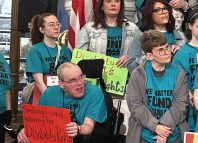







Legislators Discuss State Budget Proposal at Legislative Breakfast, Hosted by the Luzerne Wyoming County Providers Association



Message from the PA Department of Human Services (DHS):
Under the current federal administration, the U.S. Department of Homeland Security (U.S. DHS) has lifted restrictions that previously prohibited Immigration and Customs Enforcement (ICE) and Customs and Border Protection (CBP) officers from carrying out immigration enforcement actions, including arrests, in protected areas such as medical and behavioral health care facilities and social services establishments. It is now possible that U.S. DHS may attempt to conduct immigration enforcement activities in these settings.
The Pennsylvania Department of Human Services, along with the departments of Aging, Drug and Alcohol Programs, and Health, has prepared a non-regulatory advisory to provide general information about federal law applicable to immigration enforcement activities at health care and social services facilities. We also advise facility leadership and counsel to develop a written policy and standard operating procedures for what to do if immigration enforcement agents arrive on facility property or seek information about individuals you serve for immigration enforcement reasons.
In developing these policies and procedures, the Pennsylvania Department of Human Services advises that you consider:
This advisory does not provide legal advice. Consult a licensed attorney or accredited representative for legal questions about a specific situation.
Thank you for your service to Pennsylvania.


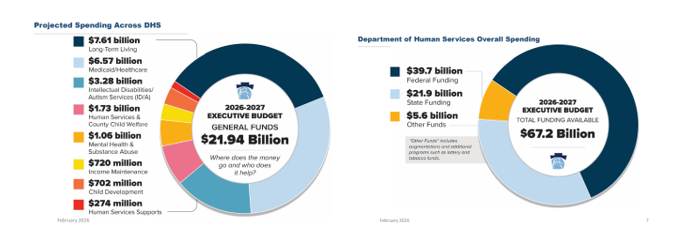
On Friday, February 6, Department of Human Services (DHS) Secretary Val Arkoosh presented an overview of Governor Shapiro’s proposed Fiscal Year (FY) 2026/27 budget and detailed the projected spending across DHS, which totals $21.94 billion in state funding. The Secretary highlighted that all three Medicaid managed care programs, as well as waiver programs for people with intellectual disabilities and autism, are receiving increases, largely driven by patient needs and costs associated with delivering care. The proposed FY 2026/27 budget includes $39.7 billion in federal funding as well as $5.6 billion from augmentations and additional programs, such as lottery and tobacco funds, making the total DHS funding $67.2 billion.
The Secretary expressed how the proposed budget reflects the direct impacts of HR 1, with significant federal funding at risk. The distribution for the 2026/27 budget is based upon the current structure of Medicaid and other federally funded programs, but the Secretary noted that beginning in 2028, changes in Medicaid financing rules will remove $20 billion from Pennsylvania’s Medicaid program over the following decade.
Budget Highlights and Investments
Due to technical difficulties, DHS was unable to record the webinar, but the presentation slides and transcript can both be viewed.
Please contact your RCPA Policy Director with any questions or concerns.


Advocate for yourselves and others by meeting with legislators directly! Take the opportunity to join RCPA as we hold our annual Capitol Day this year on Wednesday, March 25. We will hold a press conference in the Main Rotunda between 10:00 am – 11:00 am, which will include legislators and leaders in human services.
You can register for our Capitol Day press conference by contacting Christine Tartaglione. Please let us know if additional staff or colleagues within your organization are planning to attend Capitol Day with you.
RCPA requests that members schedule appointments with their Senate and House legislators directly to discuss the state budget, legislation, and regulations either prior to or immediately after our press conference. If you have questions or concerns regarding scheduling an appointment with a legislator, please contact Jack Phillips, Director of Government Affairs.
We ask that you use RCPA’s 2026 legislative priorities during your legislative visits. As an additional resource, members can visit the Pennsylvania Capitol website to locate parking and view maps of the building, and you may use the following resources for coordinating your day at the Capitol:
If you have questions regarding our 2026 Capitol Day, please contact Jack Phillips. We look forward to seeing you at the Capitol!
 Prev
Prev