';
Brain Injury

Over the past few months, there have been important changes to SNAP that may affect Pennsylvanians’ eligibility for the program.

To help SNAP recipients and those who work with them understand what’s new, the PA Department of Human Services (DHS) has posted a new video to their YouTube channel. The video explains changes to SNAP over the past six months, including who is subject to new work and reporting requirements, how to meet those requirements, and tools that are available to help Pennsylvanians meet the requirements.

0 463

The National Association of State Head Injury Administrators (NASHIA) will be offering a free webinar that will focus on Brain Injury Resource Facilitation (BIRF) and the new Moody Implementation Guide. This free webinar will be conducted on May 6, 2026, from 1:00 pm – 2:00 pm.

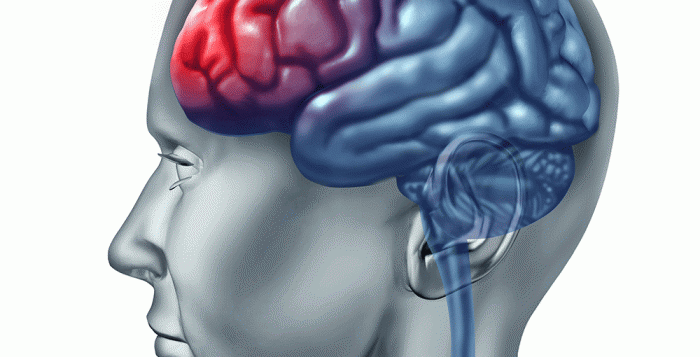
Brain Injury Resource Facilitation is a structured intervention that connects individuals with brain injury to essential resources to enhance independence and improve outcomes, using a flexible, person-centered approach. It involves needs assessment, resource navigation/service connection, and progress monitoring to identify a person’s strengths and challenges to set goals and coordinate supports. BIRF is an effective intervention for academic, employment, and community success.

This webinar will include a discussion of BIRF and the new Resource Facilitation Implementation Guide, geared towards addressing these challenges and providing a map to follow for best practice in this area. Funded by the Moody Endowment and created collaboratively through NASHIA, this guide will be a current and future tool for consistent service delivery and data collection/utilization for rationale to sustain these supports.

To participate in this webinar, registration is required.

Time is running out to submit your workshop proposal for the RCPA 2026 Conference Power in Purpose: Promoting Possibilities. The Conference will be held September 29 – October 2 at the Hershey Lodge for a statewide audience, and RCPA’s Conference Committee is looking for workshop proposals in every area for possible inclusion, particularly those that assist providers in developing and maintaining high-quality, stable, and effective treatments, services, and agencies in an industry where change is constant.

The deadline for submissions is COB Monday, March 23, so don’t wait to submit your proposals! The committee looks for presentations that:

  • Discuss strategies for C-Suite leadership to advance their organization with adapting to challenges and opportunities;
  • Provide guidance on building a culture of a committed workforce, including recruitment and employee development as well as effective remote workforce strategies;
  • Highlight new policy, research, and treatment initiatives, such as the use of artificial intelligence and technology in service provision;
  • Provide specific skills and information related to individual and organizational leadership development and enhancement;
  • Discuss advanced ethics practices and suicide prevention; and/or
  • Address system changes that affect business practices, including integrated care strategies, value-based purchasing, performance-based contracting, acquisitions and mergers, and alternative payment models.

The committee welcomes any proposal that addresses these and other topics essential to brain injury, medical rehabilitation, mental health, substance use disorder treatment, children’s health, aging, physical disabilities, autism, and/or intellectual/developmental disabilities. Members are encouraged to consider submitting, and we highly encourage you to forward this opportunity to those who are exceptionally good speakers and have state-of-the-art information to share.

The Call for Proposals (featuring a complete listing of focus tracks) and accompanying Guidelines for Developing Educational Objectives detail requirements for submissions. The deadline for submissions is COB Monday, March 23, 2026. Proposals must be submitted electronically with the form provided; confirmation of receipt will be sent. Proposals submitted after the deadline may not be considered.

If the proposal is accepted, individuals must be prepared to present on any day of the conference. Workshops are 90 minutes in length. If the topic requires an in-depth presentation, a double session can be scheduled for a total of 180 minutes. At the time of acceptance, presenters will be asked to confirm the ability to submit workshop slides and handouts electronically two weeks prior to the conference. Individuals unable to meet this expectation may not have their materials available to participants during the conference.

Individuals are welcome to submit more than one proposal; however, we ask that you submit no more than three total. Notification of inclusion for the conference will be made via email by Monday, May 11, 2026. Questions may be directed to Carol Ferenz, Conference Coordinator.

On February 28, 2026, the Department of Human Services (DHS) Office of Long-Term Living (OLTL) published a notice in the Pennsylvania Bulletin announcing a change in the fee schedule rates in the OBRA Waiver and the Act 150 Program for Participant-Directed Personal Assistance Services (PAS) procedure codes W1792 and W1792 TU. This fee schedule rate change is effective January 1, 2026. A revised fee schedule is available here.

Written comments regarding these fee schedule rates can be sent to the Department of Human Services, Office of Long-Term Living, Bureau of Policy Development and Communications Management, P.O. Box 8025, Harrisburg, PA 17105-8025. Comments can also be submitted via email. Comments received within the 30-day comment period will be considered in subsequent revisions to the fee schedule.

OLTL previously issued a listserv on December 19, 2025, confirming the Fiscal Year 2025/26 budget, signed into law on November 12, 2025, which included a $21 million investment to strengthen the workforce through increased wages for direct care workers (DCW) providing services in the Participant-Directed model for OLTL Fee-for-Service programs.

To support the January 1, 2026, effective date, OLTL updated the PROMISe™ system and the Home and Community Services Information System (HCSIS) with the revised rates. Service Coordinators (SC) did not need to make any service plan updates for the rate change, as a HCSIS system-wide update was implemented to make the necessary service data rate updates to the affected service plans.

SCs are encouraged to reach out to OBRA Waiver and Act 150 Program participants that utilize Participant-Directed PAS to ensure they are aware of the rate change and that their DCWs may receive increases in their pay rates.

SCs may also receive specific questions from OBRA Waiver and Act 150 Program participants that utilize Participant-Directed PAS supported by Financial Management Services (FMS) through the FMS vendor Public Partnerships, LLC (PPL). SCs should refer participants to the PPL Customer Service hotline at 877-908-1750 for specific questions about how the rate increase in the OBRA Waiver and Act 150 Program will impact the pay of their DCWs.

0 688

From RCPA member Beechwood NeuroRehab:

March is Brain Injury Awareness Month, a time to raise awareness, share knowledge, and support those affected by brain injuries. In recognition of this important month, we invite you to join the Beechwood clinical team for a special Zoom presentation, “Bridging the Gap to Independence.”

Wednesday, March 25, 2026

4:00 pm – 5:30 pm

Brain injuries affect millions of individuals and families each year. These injuries can be caused by falls, motor vehicle accidents, sports impacts, medical conditions, or other traumatic events. While some effects are visible, many survivors live with invisible challenges such as cognitive changes, fatigue, memory issues, and emotional impacts. In this presentation, the clinical team will share how Beechwood can help participants navigate around many of the challenges associated with having sustained an acquired brain injury, discuss their specialties, and talk about how they help participants become as independent as possible.

Join the Zoom Presentation

The U.S. Department of Labor’s (DOL) Wage and Hour Division (WHD) published a proposed rule concerning the process and criteria used to determine a worker’s classification as an employee or an independent contractor under the Fair Labor Standards Act and related federal laws.

This proposed rule would rescind DOL’s 2024 Final Rule addressing the classification of independent contractors and replace it with an analysis for employee classification similar to the one adopted by DOL in 2021. The classification analysis in the proposed rule would:

  • Apply an “economic reality” test to determine whether a worker is in business for himself or herself as an independent contractor or is an employee economically dependent on an employer for work;
  • Identify and explain two “core factors” to help determine if a worker is economically dependent on an employer for work or in business for him- or herself:
    • The nature and degree of control over the work; and
    • The worker’s opportunity for profit or loss based on initiative and/or investment;
  • Identify other factors to help determine a worker’s status as an employee or independent contractor, including the amount of skill required for the work, degree of permanence of the working relationship, and whether the work is part of an integrated unit of production;
  • Advise that the actual practice of the worker and the potential employer is more relevant than what may be contractually or theoretically possible; and
  • Provide eight fact-specific examples applying the factors to real-life circumstances.

Last year, DOL published guidance advising WHD field staff on the analysis to apply when determining employee or independent contractor status. That guidance instructed agency investigators to stop applying the analysis from DOL’s 2024 rule in current enforcement matters but, instead, rely on the principles outlined in Field Assistance Bulletin No. 2025-1 and Fact Sheet #13.

The 2024 final rule prompted a number of federal lawsuits challenging its legality. As a result, DOL said last year that it would be “…reconsidering the 2024 Rule, including whether to rescind the regulation.”

DOL will be accepting comments on this proposed rule through 11:59 pm (ET) April 28, 2026.

Message from the PA Department of Human Services (DHS):

Under the current federal administration, the U.S. Department of Homeland Security (U.S. DHS) has lifted restrictions that previously prohibited Immigration and Customs Enforcement (ICE) and Customs and Border Protection (CBP) officers from carrying out immigration enforcement actions, including arrests, in protected areas such as medical and behavioral health care facilities and social services establishments. It is now possible that U.S. DHS may attempt to conduct immigration enforcement activities in these settings.

The Pennsylvania Department of Human Services, along with the departments of Aging, Drug and Alcohol Programs, and Health, has prepared a non-regulatory advisory to provide general information about federal law applicable to immigration enforcement activities at health care and social services facilities. We also advise facility leadership and counsel to develop a written policy and standard operating procedures for what to do if immigration enforcement agents arrive on facility property or seek information about individuals you serve for immigration enforcement reasons.

In developing these policies and procedures, the Pennsylvania Department of Human Services advises that you consider:

  • Designating legal and administrative point person(s) by name and phone number who will interact with immigration agents and review legal documents;
  • Planning for how your facility will respond to requests for information, requests to enter non-public spaces to conduct an arrest, and immigration enforcement activity in public spaces;
  • Engaging in advance with stakeholders and necessary resources; and
  • Minimizing disruption to individuals served.

This advisory does not provide legal advice. Consult a licensed attorney or accredited representative for legal questions about a specific situation.

Thank you for your service to Pennsylvania.