





RCPA Member Merakey to Host 5th Annual Dual Diagnosis Virtual Conference on February 25, 2026


Under new federal rules, to keep or become eligible for SNAP benefits, some recipients will have to meet work requirements that include working, volunteering, or participating in an education or training program for at least 20 hours a week (or 80 hours each month) AND report that they are meeting these work requirements.
To help SNAP recipients and applicants find out if they need to meet this requirement, the Pennsylvania Department of Human Services (PA DHS) has launched a new online screening tool.
By answering a simple set of yes or no questions, SNAP applicants and recipients can find out if they need to meet the work requirements, if they are already meeting the work requirements, or if they are eligible for an exemption.
The screening tool is not a final determination of whether someone is meeting the work requirements or is eligible for an exemption, but it can help recipients and applicants have a more informed conversation with their caseworker.
The new work requirements will apply to Pennsylvanians who:
In addition, being a veteran or a current or former foster youth age 18–24 will no longer be an exemption.
Some people may still be exempt from work and reporting requirements if they meet a different exemption. You can learn more about these work reporting requirements, who they affect, and more about exemptions at DHS’s website.
State Budget Investments Help Fight Food Insecurity
Pennsylvania’s charitable food network and our agricultural community are vital to keeping our neighbors and communities fed. Governor Shapiro’s 2025/26 budget delivers major investments to combat hunger, strengthen the charitable food network, and support Pennsylvania farmers. The budget includes a historic $11 million increase for food security, including:
Help Us Spread the Word
PA DHS has developed a communications toolkit to help Pennsylvanians understand the changes happening to SNAP.
We ask RCPA members, advocates, and stakeholders to view and share the toolkit, which includes sample text, social media posts, and more.

From Chaos to Clarity: How Human Service Leaders Bring Order to Oversight
Tuesday, December 9, 2025
12:00 pm ET
Register Here
Keeping up with inspections and licensing requirements can feel like an endless chase — especially when each site or program has its own system. Many organizations are finding new ways to bring structure, visibility, and calm to these responsibilities, even with limited resources.
Join us on Tuesday, December 9, 2025, at 12:00 pm ET for From Chaos to Clarity: How Human Service Leaders Bring Order to Oversight, a live webinar co-hosted by RCPA and PUPS Software. This session brings together leaders for an open, practical conversation about streamlining inspections, licensing, and operational readiness.
Featured Panelists:
We’ll talk about:
Whether your team is just getting started or already modernizing oversight, you will walk away with useful ideas, peer insights, and tools to support your next steps.

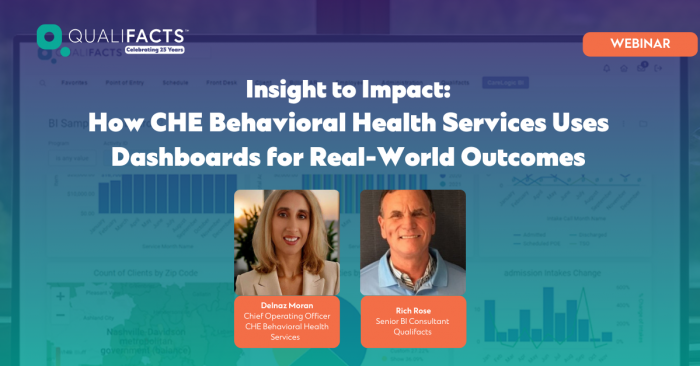
Insight to Impact: How CHE Behavioral Health Services Uses Dashboards for Real-World Outcomes
Featuring: CHE Behavioral Health Services & Qualifacts
Wednesday, December 3, 2025
1:00 pm ET; 12:00 pm CST
Register Here
In just over a year, CHE Behavioral Health Services leveraged Qualifacts’s modern Business Intelligence (BI) solution — an integrated data and analytics visualization platform delivering critical insights — to revolutionize its operations. The result? Improved financial performance, reduced denials, enhanced provider productivity, and board-ready reporting.
Join this webinar to see how CHE scaled dashboards across 11 states, built role-specific dashboards and reports, and turned data into meaningful, motivating narratives.
This webinar will:
Featured Speakers:
Delnaz Moran
Chief Operating Officer, CHE Behavioral Health Services
Delnaz develops CHE’s overarching business strategy and implements workflows and resource allocation models that drive growth, operational excellence, and clinical impact. Her experience spans leadership roles across healthcare operations, behavioral health, and applied behavior analysis — each focused on improving access and outcomes for vulnerable populations.
Rich Rose
Senior Business Intelligence Consultant, Qualifacts
With nearly 30 years of experience in Quality and Compliance, Rich began his career with the Indian Health Service before leading quality improvement and compliance at an Oregon behavioral health program. Today, he helps organizations leverage Qualifacts’s BI tools to track outcomes and transform data into decision-making power.

From Pennsylvania Capital-Star “Pa.’s Rural Health Application Reveals Priorities in Federal Funding Request,” November 20, 2025:
Pennsylvania is hoping to secure its own slice of a $50 billion rural health fund in the face of federal Medicaid cuts, with a focus on bolstering a beleaguered workforce and expanding health access for more than two million people.
The Rural Health Transformation Fund was a last-minute addition to President Donald Trump’s summer budget bill that imposed Medicaid work requirements and cut upwards of $51 billion in funding to the commonwealth over the next decade. That new fund is worth roughly 37% of the estimated lost Medicaid funding in rural areas…
The 67-page application requests up to $200 million in annual funding over the next five years, totaling $1 billion. Its six focuses include: technology and infrastructure, workforce, maternal health services, behavioral health services, aging and access, and emergency medical services and transportation.
The U.S. Department of Human Services is expected to award funding by the end of the year.
Key objective targets are:
From the PA Rural Health Transformation (RHT) Program Application:
Pennsylvania’s rural health transformation strategy is grounded in a balance of statewide coordination and regional leadership and collaboration. Pennsylvania’s “Health Hub” state agencies (Human Services, Health, Aging, Insurance, Drug and Alcohol Programs), and other partner agencies will establish clear strategic priorities focusing on access, workforce, maternal health, aging, behavioral health, EMS and infrastructure. Pennsylvania will leverage statewide technical expertise, evaluation, and financial oversight and support. Strong regional rural care collaborative will be composed of a roster of regional stakeholders that prioritize local needs, develop effective local sustainable solutions, and leverage existing resources and assets.
Pennsylvania will leverage established regional entities that coordinate regional economic development. These Partnerships for Regional Economic Performance (PREP) organizations are long-standing, quasi-governmental organizations that convene regional stakeholders, administer federal and state grants, collect local data, report outcomes, and catalyze public and private partnerships for regional economic development. They bring established governance structures, convening power, and a track record of successful cross-sector collaboration. PREPs (Figure 2) will convene regional stakeholders to create Rural Care Collaborative (RCCs) to align initiatives with regional economic planning and development – making the RHTP investments sustainable and promoting long-term partnerships.
If you have any questions, please contact RCPA COO and Mental Health Policy Director Jim Sharp.

Mental Health America has released their State of Mental Health in America 2025 Report. The report highlights the latest national data and provides state-level rankings on mental health and wellbeing in the U.S. It serves as a collection of data across all 50 states and the District of Columbia, with the goal of providing a snapshot of mental health status among youth and adults, tracking changes in prevalence of mental health issues and access to mental health care, and understanding how changes in national data reflect the impact of legislation and policies.
The report highlights:
Pennsylvania ranked 7th in the overall rankings, indicating a lower prevalence of mental illness and higher rates of access to care. Individually, PA was ranked 4th in access to care, 30th in prevalence of any mental illness, and 31st in mental health workforce availability.
Read the full report here. Please contact Emma Sharp with any questions.
RCPA member The Alliance of Community Service Providers’ 22nd Annual Conference for Direct Service Professionals will take place on Friday, February 27, 2026, from 8:00 am – 4:00 pm at the Hilton Philadelphia City Avenue.
This year’s theme — Celebrating Our Journey…Charting the Path Ahead — honors the extraordinary work of Direct Service Professionals across our region and reaffirms the Alliance’s commitment to moving human services forward. It promises to be an energizing day of learning, connection, and celebration.
Workshop Proposals:
The Alliance of Community Service Providers is now accepting workshop proposals for this year’s conference. If you or members of your team are interested in presenting, please review the Request for Proposals (RFP). Proposals are due no later than December 31, 2025. Notifications of accepted workshops will be sent by mid-January. Please submit your RFPs electronically.
Sponsorship Opportunities:
Once again, the Alliance is pleased to offer a range of sponsorship opportunities for organizations that wish to support the conference and show their commitment to the DSP workforce.
Sponsorship is a great way to:
View the form for key information, and please email Michael or Cherie to indicate your intention to sponsor.
Save the Date & Spread the Word:
Please mark your calendars for February 27, 2026, and feel free to begin sharing the announcement within your networks. We look forward to another outstanding conference that brings our community together and strengthens the future of human services.

The Pennsylvania Department of Drug and Alcohol Programs (DDAP) will host its Annual Women and Children’s Meeting from 10:00 am – 12:00 pm on Wednesday, December 10. The virtual meeting provides an opportunity to connect, collaborate, and share updates on programs and initiatives that support women and children across the Commonwealth. Participants will hear from county administrators and receive statewide updates highlighting innovative efforts and best practices related to supports and services for women and children in Pennsylvania.
Use the information below to join the meeting or add the meeting to your calendar.
Join the meeting
Meeting ID: 251 287 171 369 74
Passcode: RJ2pc2fR
Dial in by phone
+1 267-332-8737,,471562118# (United States, Philadelphia)
Find a local number
Phone conference ID: 471 562 118#
 Prev
Prev