




National Council’s Group Purchasing Program

Join RCPA as we host the 2026 Annual Conference Power in Purpose: Promoting Possibilities from September 29 – October 2 at the Hershey Lodge. The event is a highlight for the Pennsylvania behavioral health, brain injury, children’s, early intervention, intellectual and developmental disabilities, medical rehabilitation, and physical disabilities and aging provider communities. RCPA staff and the Conference Committee are excited to release this year’s Sponsors, Exhibitors, and Advertiser Brochure, which features many opportunities to get in on the action and network with providers. Booth self-selection will also be available for exhibitors and exhibiting sponsors. In order to be considered for self-selection, a completed contract with payment must be submitted.
 Network and Compete in Connections Hall
Connections Hall activities take place during the two busiest days of the conference, and many networking opportunities are available throughout the event. You’ll also be able to compete and have a chance to win “Best of Show!”
Exciting Sponsorship Opportunities
RCPA is privileged to have the backing of the finest organizations in the field for our conference. Through the use of sponsorship circles, RCPA is able to honor all supporting organizations.
Sign Up Now!
Sponsors, exhibitors, and advertisers who wish to be listed on the website, on the mobile app, and in the conference program must submit all materials by Tuesday, September 8.
 The association looks forward to welcoming you at the conference! Space and opportunities are reserved on a first-come, first-served basis, and no reservation is considered complete without payment. If questions remain, please contact Carol Ferenz, Conference Coordinator.
On January 29, 2026, President Trump signed an Executive Order to create the White House Great American Recovery Initiative in an effort to coordinate a federal response to addiction across America and prevent fatal overdoses. This new initiative serves as part of Trump’s commitment to ending the addiction crisis and ensuring Americans have access to the support and care they need.
The Great American Recovery Initiative will be led by Health and Human Services Secretary Robert F. Kennedy Jr., along with Senior Advisor for Addiction Recovery Kathryn Burgum, and will also include the Attorney General, Interior, Labor, Housing and Urban Development, and Veterans Affairs Secretaries.
Primary goals of the initiative include increasing addiction awareness, advising agencies on program implementation, advising agencies on directing appropriate grants to support addiction recovery, and consulting with states and other entities to ensure Americans have access to addiction treatment. The White House also released a fact sheet to detail the goals of the initiative and their current progress in addiction treatment.
Secretary Kennedy is scheduled to appear Monday, February 2, 2026, to discuss more details and announce another initiative related to mental health and addiction. RCPA will continue to update members as information becomes available.
RCPA continues to seek proposals for the 2026 Annual Conference Power in Purpose: Promoting Possibilities, which will be held September 29 – October 2 at the Hershey Lodge for a statewide audience. RCPA’s Conference Committee is looking for workshop proposals in every area for possible inclusion, particularly those that assist providers in developing and maintaining high-quality, stable, and effective treatments, services, and agencies in an industry where change is constant. The committee looks for presentations that:
 leadership to advance their organization with adapting to challenges and opportunities;
The committee welcomes any proposal that addresses these and other topics essential to brain injury, medical rehabilitation, mental health, substance use disorder treatment, children’s health, aging, physical disabilities, autism, and/or intellectual/developmental disabilities. Members are encouraged to consider submitting, and we highly encourage you to forward this opportunity to those who are exceptionally good speakers and have state-of-the-art information to share.
The Call for Proposals (featuring a complete listing of focus tracks) and accompanying Guidelines for Developing Educational Objectives detail requirements for submissions. The deadline for submissions is COB Monday, March 23, 2026. Proposals must be submitted electronically with the form provided; confirmation of receipt will be sent. Proposals submitted after the deadline may not be considered.
 If the proposal is accepted, individuals must be prepared to present on any day of the conference. Workshops are 90 minutes in length. If the topic requires an in-depth presentation, a double session can be scheduled for a total of 180 minutes. At the time of acceptance, presenters will be asked to confirm the ability to submit workshop slides and handouts electronically two weeks prior to the conference. Individuals unable to meet this expectation may not have their materials available to participants during the conference.
Individuals are welcome to submit more than one proposal; however, we ask that you submit no more than three total. Notification of inclusion for the conference will be made via email by Monday, May 11, 2026. Questions may be directed to Carol Ferenz, Conference Coordinator.
The Pennsylvania Department of Drug and Alcohol Programs (DDAP) is awarding more than $1.2 million to expand access to recovery housing and recovery support services throughout Pennsylvania for young adults 18–24 years old who have opioid or stimulant use disorders. DDAP is awarding grants to nine Single County Authorities (SCA) to fund the effort.
Currently, there are about 430 DDAP-licensed recovery houses across the Commonwealth. The purpose of the Administration’s licensure program is to help empower sustained recovery for individuals with substance use disorder (SUD) by ensuring a network of safe drug and alcohol recovery houses. Drug and alcohol recovery houses are required to be licensed in order to receive referrals from state agencies or state-funded facilities or to receive federal or state funding to deliver recovery house services.
The grant funds will be used to supplement existing resources, ensuring that current services are expanded rather than replaced, and that recovery housing remains accessible and safe through Pennsylvania.
DDAP is awarding nine grants, which will run through September 30, 2026, to the following SCAs serving 14 counties:

The Department of Human Services (DHS) has launched a new website for the PA Rural Health Transformation Plan, containing information on goals as well as links to the full plan and news updates.
While a formal RFP process has not yet been released, providers can submit the following inquiry form. This brief survey provides each organization with an opportunity to introduce your agency and services you offer, ask questions regarding the Rural Health Transformation Plan, and identify the Rural Care Collaborative region(s) where you and/or your organization is based or provides services (see map below). Once submitted, DHS will review and respond to your inquiry as soon as possible.
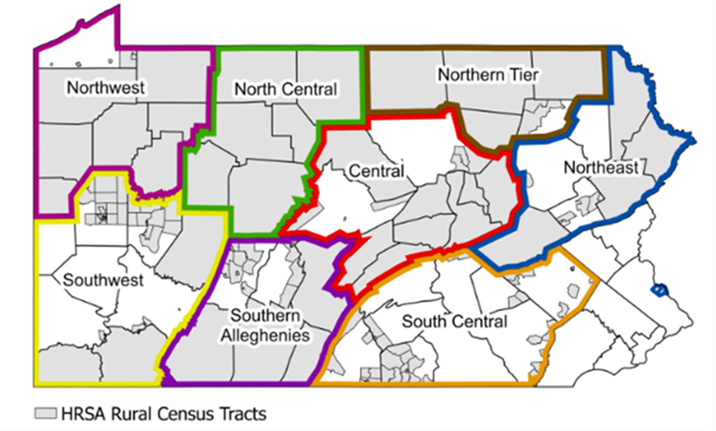
Providers and stakeholders may also sign up for updates on the Rural Health Transformation Plan.
If you have any questions, please contact RCPA COO Jim Sharp.
RCPA will reengage with all members, non-members, and systems-wide behavioral health stakeholders to participate in the Mental Health Safety Net Coalition. The Coalition is focused on developing strategies, activities, and engagement opportunities to support behavioral health funding in the Commonwealth.
The Coalition will have its first meeting on Friday, February 13, 2026, from 12:00 pm – 1:00 pm. This meeting will give the group an opportunity to review last year’s budget, Governor Shapiro’s proposed budget, and initial strategies for the Fiscal Year (FY) 2026/27. It will also give us an opportunity to develop questions for legislators for the DHS budget hearings in late February and early March. Register for the meeting by contacting Emma Sharp, RCPA Policy Associate.
As the group continues to meet, we will develop our overall advocacy blueprint to ensure the communication of our message and stakeholder engagement is focused on protecting and preserving our mental health service delivery system.
The meetings will be held via Microsoft Teams; information will be sent to those interested in the Coalition. RCPA invites all to participate. If you would like to join the Coalition or have any questions, please contact Emma Sharp.

 Prev
Prev