




';
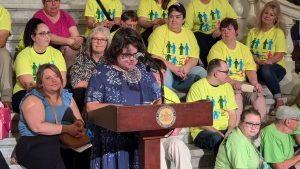
The United States Senate Special Committee on Aging will be holding a hearing tomorrow to discuss the long-term care workforce. The hearing will be to address the shortages and legislation to improve the caring professions. U.S. Senator Bob Casey (PA), Chairman of the Committee, has invited Nick Smith, an NADSP-certified direct support professional from Philadelphia, to provide testimony. It is rare that direct support professionals have the opportunity to testify before the United States Senate, and NADSP invites you to watch Mr. Smith on Tuesday. Insights gained from such hearings can inform the development of legislation aimed at addressing workforce issues.
HOW TO WATCH:
The hearing will be livestreamed on the committee page. To access the livestream, visit here. Details are below:
United States Senate Special Committee on Aging
Full Committee Hearing
Tuesday, April 16, 2024
10:00 am (EDT)
Featuring Nick Smith, DSP-1, SPIN, Philadelphia, PA
The National Association of State Directors of Developmental Disabilities Services (NASDDDS) has announced the second installment of the Adaptive Strategies Video Series. The Dialectical Behavior Therapy (DBT) series was written and led by the Missouri Department of Mental Health and a stellar group of professionals from that state. The project has been an enormous undertaking and a true labor of love by professionals and clinicians in both Missouri (DBT series) and Louisiana (CBT series). We want to particularly highlight staff from Missouri since inadvertently not providing them appropriate credit in our original announcement. A special thank you to Dr. Sharon Robbins, Dr. Lucas Evans, Dr. Jessica Sergio, and Dr. Brandy Baczwaski for their incredible contributions to this body of work currently positioned to make a significant impact on the experiences of people with I/DD nationally. We would also like to thank Dr. Angeline Stanislaus, Chief Medical Director at the Missouri Department of Mental Health, along with Jessica Bax, Director of the Missouri Division of Developmental Disabilities, and Valerie Huhn, Director of the Missouri Department of Mental Health, for their leadership and support of this project.
We would also be remiss not to take a moment to mention the team from Louisiana who led the work on the first Adaptive Strategies series, Cognitive Behavioral Therapy (CBT). We would like to thank Julie Foster-Hagan, Assistant Secretary at the Office for Citizens with Developmental Disabilities at the Louisiana Department of Health for her leadership and support. We are also incredibly grateful to Dr. Brandi Kelly and Dr. Tab Bounds for their innovative vision and immense contributions to this project.
Despite long-held beliefs that people with intellectual and/or developmental disabilities (I/DD) may not benefit from mental health treatment, we know that people with I/DD can successfully utilize integrated medical, mental, and behavioral healthcare (Ervin, Williams, and Merrick, 2014). NASDDDS is pleased to announce the second installment of its Adaptive Strategies video series featuring specific interventions and treatments highlighting modifications and adaptations for people with I/DD.
People with I/DD experience behavioral and physical health issues at rates higher than the general population and can benefit from the same evidence-based interventions that are used for people without I/DD. This second installment in the video series, developed in collaboration with Louisiana’s Office for Citizens with Developmental Disabilities, will focus on modifying Dialectical Behavior Therapy (DBT) for people with I/DD.
The Office of Developmental Programs (ODP) is hosting a series of public comment webinars to provide an overview of how it proposes to implement performance-based contracting for residential services effective January 1, 2025. Additional proposed changes to the Consolidated, Community Living, and Person/Family-Directed Support Waivers that are not related to performance-based contracting will also be covered.
The proposed changes have not been published yet. As soon as they are available to review, we will share the document with our members. We will also reconvene our Performance-Based Contracting Committee in order to develop our comments. We encourage our members to submit comments to ODP, and share your thoughts with us as well to include in our response.
Sessions will be held for specific stakeholder groups. Preregistration is required. To register, follow the registration link under the session that best defines your role. Registered participants will have the opportunity to provide verbal comments on the waiver amendment during the session.
Registration Link
The Office of Developmental Programs (ODP) has updated ODPANN 24-015: Implementing Changes to Remote Supports and Assistive Technology in the November Waiver Amendments. The original release of the communication was missing the guidance for implementing changes to assistive technology. Please note: this has been corrected with this update. All new information is included in red. Please use this version of the communication going forward.
To celebrate the diversity of individuals with autism, the Office of Developmental Programs (ODP) encourages you to be active participants within your home and communities! Throughout Autism Acceptance Month, ODP will be holding autism trainings throughout the month of April. You are invited to join these trainings, as they discuss what autism is, how to teach skills, address risk, and apply best practices. These trainings will be recorded and posted to MyODP in May 2024.
The attached documents offer tips for embracing autism in your community and a full listing of ODP autism trainings in April!
Training Schedule:
The Office of Developmental Programs (ODP) has shared the attached communication, ODPANN 24-035: Action Required in Preparation for Enterprise Case Management (ECM). This communication is to request providers’ assistance in updating their contact information and service information to ensure accuracy in the Home and Community-Based Services System (HCSIS) and in PROMISe™ prior to the Enterprise Case Management (ECM) transition. Please review the announcement for additional information and detail.
ATTACHMENTS:
The 2024 Virtual Dual Diagnosis Conference, titled “Full Diagnosis: Impact of Trauma, Physical Health, and Metabolic Health,” will take place on Saturday and Sunday, May 22 and 23, 9:00 am to 4:00 pm. Hosted by The Pennsylvania Department of Human Services, Office of Developmental Programs, and Office of Mental Health and Substance Abuse Services, the conference features nationally recognized speakers who will explore various perspectives on these crucial issues. Featured speakers include Dale Adair, MD, FAPA, Syard Evans, PhD, Beth Barol, Stacy Nonnemacher, Self Advocates United as 1, Brandi Kelly, PhD, and Dan Dubovsky. Registration for the conference is open.
If you have any questions, please contact RCPA COO and Director of Mental Health, Jim Sharp.

On Monday, April 8, 2024, there will be an eclipse event and parts of Pennsylvania will have a view of a total solar eclipse. The Office of Developmental Programs (ODP) is reminding everyone that it is not safe to directly view an eclipse with the unprotected eye. Severe eye damage or blindness can occur. It is only safe to view an eclipse through specialized eye protection for solar viewing. Regular sunglasses, even if they are very dark, will not protect your eyes. Viewing any part of the bright sun through a camera lens, binoculars, or a telescope without a special-purpose solar filter secured over the front of the lenses will instantly cause severe eye injury.
When considering any outdoor activities during the eclipse, be aware that some individuals may not understand the risk for eye damage and blindness by looking at the sun without protect eyewear or may be at risk to remove their protective eyewear.
The National Aeronautics and Space Administration (NASA) has created a website with information about safe eclipse viewing.