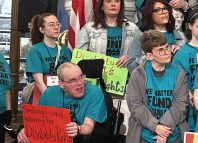






CMS Issues Guidance on Medicaid Eligibility Determinations


RCPA staff and the Conference Committee have released this year’s Sponsors, Exhibitors, and Advertiser Brochure, which features many opportunities to get in on the action and network with providers. Booth self-selection will also be available for exhibitors and exhibiting sponsors. In order to be considered for self-selection, a completed contract with payment must be submitted.
 Network and Compete in Connections Hall
Connections Hall activities take place during the two busiest days of the conference, and many networking opportunities are available throughout the event. You’ll also be able to compete and have a chance to win “Best of Show!”
Exciting Sponsorship Opportunities
RCPA is privileged to have the backing of the finest organizations in the field for our conference. Through the use of sponsorship circles, RCPA is able to honor all supporting organizations.
Sign Up Now!
Sponsors, exhibitors, and advertisers who wish to be listed on the website, on the mobile app, and in the conference program must submit all materials by Tuesday, September 8.
 The association looks forward to welcoming you at the conference! Space and opportunities are reserved on a first-come, first-served basis, and no reservation is considered complete without payment. If questions remain, please contact Carol Ferenz, Conference Coordinator.
As the Pennsylvania Department of Human Services (DHS) prepares for the upcoming changes in the federal Medicaid standards set for implementation in January 2027, DHS has convened a statewide HR1 Steering Committee. This group is tasked with reviewing policy and practice drafts from the Department as it relates to their response to the pending Medicaid changes, including new eligibility and work requirements for recipients and communicating the implementation of Pennsylvania’s overall plan.
The steering committee is comprised of state leadership, advocates, and payers. RCPA providers will be represented by RCPA President and CEO Richard Edley. RCPA’s involvement will bolster our role as a lead advocate for members and stakeholders as it relates to Medicaid HR 1 activities. Additionally, RCPA has contracted with former Pennsylvania Medicaid Director Leesa Allen to assist in developing our internal strategies and advocacy platform.
The steering committee had its initial meeting yesterday, March 5, 2026, to lay out the groundwork for the group and presented an initial PowerPoint presentation that looks at some of the foundational information around Medicaid, CHIP, and SNAP changes.
If you have questions or feedback, please contact your respective RCPA Policy Director or COO Jim Sharp.
Over the past few months, there have been important changes to SNAP that may affect Pennsylvanians’ eligibility for the program.
To help SNAP recipients and those who work with them understand what’s new, the PA Department of Human Services (DHS) has posted a new video to their YouTube channel. The video explains changes to SNAP over the past six months, including who is subject to new work and reporting requirements, how to meet those requirements, and tools that are available to help Pennsylvanians meet the requirements.
Time is running out to submit your workshop proposal for the RCPA 2026 Conference Power in Purpose: Promoting Possibilities. The Conference will be held September 29 – October 2 at the Hershey Lodge for a statewide audience, and RCPA’s Conference Committee is looking for workshop proposals in every area for possible inclusion, particularly those that assist providers in developing and maintaining high-quality, stable, and effective treatments, services, and agencies in an industry where change is constant.
The deadline for submissions is COB Monday, March 23, so don’t wait to submit your proposals! The committee looks for presentations that:
 Highlight new policy, research, and treatment initiatives, such as the use of artificial intelligence and technology in service provision;
The committee welcomes any proposal that addresses these and other topics essential to brain injury, medical rehabilitation, mental health, substance use disorder treatment, children’s health, aging, physical disabilities, autism, and/or intellectual/developmental disabilities. Members are encouraged to consider submitting, and we highly encourage you to forward this opportunity to those who are exceptionally good speakers and have state-of-the-art information to share.
The Call for Proposals (featuring a complete listing of focus tracks) and accompanying Guidelines for Developing Educational Objectives detail requirements for submissions. The deadline for submissions is COB Monday, March 23, 2026. Proposals must be submitted electronically with the form provided; confirmation of receipt will be sent. Proposals submitted after the deadline may not be considered.
 If the proposal is accepted, individuals must be prepared to present on any day of the conference. Workshops are 90 minutes in length. If the topic requires an in-depth presentation, a double session can be scheduled for a total of 180 minutes. At the time of acceptance, presenters will be asked to confirm the ability to submit workshop slides and handouts electronically two weeks prior to the conference. Individuals unable to meet this expectation may not have their materials available to participants during the conference.
Individuals are welcome to submit more than one proposal; however, we ask that you submit no more than three total. Notification of inclusion for the conference will be made via email by Monday, May 11, 2026. Questions may be directed to Carol Ferenz, Conference Coordinator.

The U.S. Department of Labor’s (DOL) Wage and Hour Division (WHD) published a proposed rule concerning the process and criteria used to determine a worker’s classification as an employee or an independent contractor under the Fair Labor Standards Act and related federal laws.
This proposed rule would rescind DOL’s 2024 Final Rule addressing the classification of independent contractors and replace it with an analysis for employee classification similar to the one adopted by DOL in 2021. The classification analysis in the proposed rule would:
Last year, DOL published guidance advising WHD field staff on the analysis to apply when determining employee or independent contractor status. That guidance instructed agency investigators to stop applying the analysis from DOL’s 2024 rule in current enforcement matters but, instead, rely on the principles outlined in Field Assistance Bulletin No. 2025-1 and Fact Sheet #13.
The 2024 final rule prompted a number of federal lawsuits challenging its legality. As a result, DOL said last year that it would be “…reconsidering the 2024 Rule, including whether to rescind the regulation.”
DOL will be accepting comments on this proposed rule through 11:59 pm (ET) April 28, 2026.


 Prev
Prev