';
Policy Areas

0 3073

RCPA has been in communication with the American Medical Rehabilitation Providers Association (AMRPA), who has been working with the Centers for Medicare and Medicaid Services (CMS) to ensure inpatient rehabilitation facilities (IRFs) do not face inappropriate non-compliance penalties related to the IRF Patient Assessment Instrument (PAI) version 4.0 that is set to go into effect tomorrow (October 1, 2022). One particular concern is new items in version 4.0 do not include a “skip logic” to account for unplanned discharges that classify as incomplete stays. This oversight could lead to many IRFs not meeting the 95 percent data completion threshold for the Inpatient Rehabilitation Facility Quality Reporting Program (IRF QRP).

Yesterday, CMS released a statement on the issue along with a Question & Answer (Q&A) document. CMS also noted that the agency will determine if a permanent fix is necessary and will release any related guidance or data specifications in the coming weeks.

The National Alliance for Direct Support Professionals (NADSP) shared this report:
Direct Support Workforce and COVID-19 National Report: 12-Month Follow-up

READ REPORT

While vaccination rates have improved among professionals supporting people with intellectual and developmental disabilities since the early days of the COVID-19 pandemic, their mental and physical health have declined, a new survey shows.

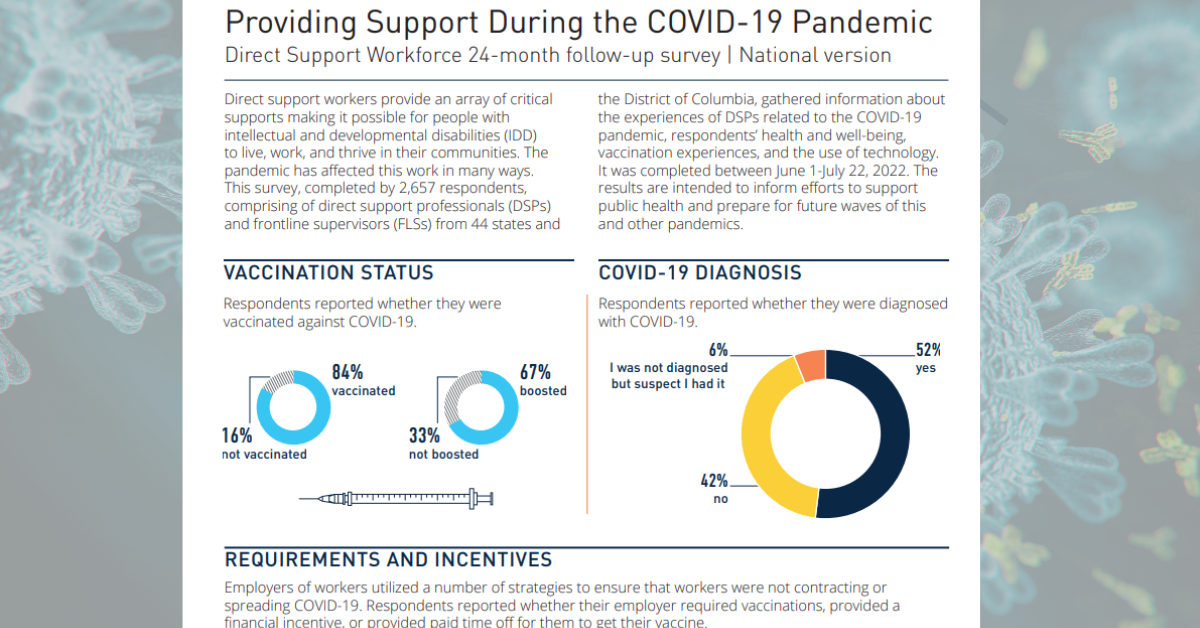
The Institute on Community Integration, in partnership with the National Alliance for Direct Support Professionals (NADSP), surveyed 2,657 DSPs and frontline supervisors about their experiences supporting people with IDD during the pandemic. The newly released survey report is a 24-month follow-up to an initial report issued in April 2020. Additional surveys were conducted six and twelve months after the initial report. The survey series represents the largest-ever national study of the DSP workforce.

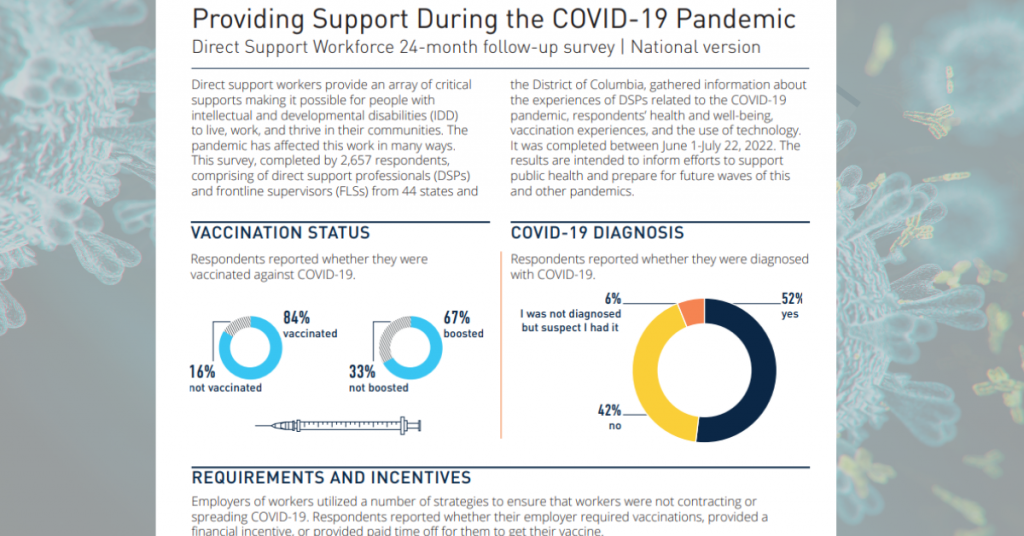
According to the report, 52% percent of DSPs reported being diagnosed with COVID-19, and 6% were not diagnosed but suspected they had it. Among employers, 65% did not require DSPs to be vaccinated.

Sixteen percent of DSPs remain unvaccinated. Of the 84% who are vaccinated, 67% reported having at least one booster shot.

While vaccination rates have improved from the 12-month survey in 2021 (from 72% to 86%), the mental wellbeing of DSPs has declined. Forty percent of DSPs reported experiencing depression, compared with 36% one year ago; 43% had difficulty sleeping, a 13% increase; and 56% reported increased anxiety, a 14% increase. Fifty-nine percent of respondents said they felt pressure to work extra hours.

“Direct support professionals and frontline supervisors have worked as hard as they can,” said Amy Hewitt, ICI director and lead investigator of the study. “This survey shows that their mental health is worsening, and we don’t have the resources to address it. Working this much overtime is not sustainable.”

A national plan to increase the size of the direct support workforce would help to alleviate multiple troubling issues, Hewitt said.

“This workforce has been overlooked and in crisis for years, with high turnover and vacancy rates, low wages, and lack of access to affordable benefits,” she said.

More than half of DSPs receive government-funded assistance, such as housing, energy, food, and healthcare. The pandemic made staffing even more difficult, increasing stress, expectations, and risk on those who remain in their positions.

The 24-month follow-up survey also looked at changes in technology use during the pandemic. Fifty-nine percent of DSPs reported using technology more or a lot more than before the pandemic. Thirty-six percent of the respondents said the use of technology had a somewhat positive impact on their work, and 14% reported it had a very positive impact. Seventeen percent reported a somewhat negative impact and 3% a very negative impact.

Read the full report, a short version, and select state-specific versions here.

Please contact Jerry Smith with questions.

Image by succo from Pixabay

Act 59 of 2017 gave the Pennsylvania Department of Drug and Alcohol Programs (DDAP) the power and duty to license drug and alcohol recovery houses that receive referrals from state agencies or state-funded facilities or federal or state funding and to impose fines on unlicensed recovery houses that receive funds from federal, state, or county agencies. On December 11, 2021, DDAP published recovery house licensure regulations in 28 Pa. Code Ch. 717. The regulations took effect immediately upon publication, except for 28 Pa. Code § 717.14, regarding fines for unlicensed recovery houses, which took effect on June 9, 2022. On June 9, DDAP gave notice that, effective July 1, 2022, to minimize disruption to residents during the application and licensure process, single county authorities (SCAs) could continue to act on existing contracts with recovery houses that were making timely and good faith efforts to obtain licensure. DDAP also expressed its position that it would not penalize recovery houses while they were actively working through the licensure process.

Beginning January 1, 2023, SCAs may only fund recovery houses that have obtained licenses from DDAP. SCAs should plan to transition individuals who remain in unlicensed recovery houses to another licensed recovery home or arrange for other suitable housing as of January 1, 2023.

The SCAs are subject to the provisions of all requirements as outlined in the 2020–2025 Grant Agreement. Any state or federal funding used to make payments to unlicensed recovery homes is a violation of Act 59 of 2017 and the terms outlined in Appendix D Program Specific Provisions, Paragraph VI Compliance/Termination/Reduction of the 2020–2025 Grant Agreement.

In addition, as of January 1, 2023, DDAP will exercise its enforcement authority to impose fines of up to $1,000 per day on persons who have not obtained licenses but who operate recovery houses that receive funds from a federal, state, or county agency, in accordance with the requirements of Act 59 of 2017 and 28 Pa. Code § 717.14. Recovery house operators who have started but not completed the licensure process must either obtain their license or stop accepting federal, state, and county funds by January 1, 2023 in order to avoid this fine.

Act 59 of 2017, 71 P.S. § 613.16(a), relating to Violations, provides:

(a) Penalties — A person operating a drug and alcohol recovery house that is funded, in whole or in part, by the department or a Federal, other State, or county agency, that has failed to attain or maintain licensure or certification of a drug and alcohol recovery house and has not been licensed or certified by the department, shall pay a fine of up to $1,000 for each violation.

28 Pa. Code § 717.14(b), relating to Fines, provides, “Each day of operating a drug and alcohol recovery house that requires a license without a current license shall constitute a separate violation.”

Please submit all questions regarding this communication to the Bureau of Program Licensure.

The Department of Human Services (DHS) Office of Long-Term Living (OLTL) has announced the launch of the American Rescue Plan Act of 2021 (ARPA) Funding Reporting portal. The online portal will be available on September 30, 2022, for OLTL providers to submit costs associated with ARPA funding distributed in 2021 in order to comply with DHS reporting requirements.

Background: ARPA Funding Information 

In 2021, federal funding from ARPA was allocated by the General Assembly under Act 24 and enacted by Governor Wolf to provide funding to nursing facilities (NF), personal care homes (PCH), and assisted living residences (ALR). These ARPA funds should be used for COVID-19 relief for costs not otherwise reimbursed by federal, state, or other sources of funding.

In addition, ARPA provided a temporary 10 percent increase to the federal medical assistance percentage (FMAP) for certain Medicaid expenditures for home and community-based services (HCBS). The funding must be used to enhance, expand, or strengthen HCBS. OLTL outlined in its plan to the Centers for Medicare & Medicaid Services (CMS) initiatives to strengthen the workforce and assist Adult Day Services (ADS) providers. The OLTL ARPA plan directed funding to Personal Assistance Service (PAS), Community Integration (CI), and Residential Habilitation (Res Hab) providers to assist with recruitment and retention of direct care workers. The plan also directed additional funding to providers to strengthen ADS.

ARPA funding must be used for things such as sign-on bonuses, retention payments, COVID-19 related leave benefits and paid time off, vaccination incentives, and/or the purchase of personal protective equipment and testing supplies. Additionally, ADS providers can use the funding for retrofitting adult daily living centers, expenses to re-open the centers, and expenses to develop alternative models to provide ADS.

Additional detailed information about the distribution of the 2021 ARPA funding can be found on the DHS Long-Term Care Providers web page.

ARPA Funding Reporting Portal
Effective September 30, 2022, providers can access the portal and begin to report ARPA 2021 costs. Providers can access the portal through the Funding Portal Login web page. The first report due date will be November 30, 2022, and should reflect two reporting periods. Providers are required to submit reports in the portal on a bi-annual basis thereafter according to their exhaustion of the funds. Please reference the chart below.

Report Period 

Due Dates 

07/01/2021 – 12/31/2021

01/01/2022 – 06/30/2022

11/30/2022
07/01/2022 – 12/31/2022 2/28/2023
 01/01/2023 – 6/30/2023 8/30/2023
 07/01/2023 – 12/31/2023 2/28/2024

Providers must keep all documentation related to the costs reported in the final cost report for a minimum of five years.

0 1641

The Council on Brain Injury (CoBI) clinical forum will be presenting a webinar on November 8, 2022, from 3:30 pm – 5:00 pm. This webinar, titled “Recreational Therapy: Implications for Life Care Planning After Brain Injury,” will focus on how recreational therapy (RT) can help to support health promotion, prevention of secondary conditions, and quality of life. RT can also contribute to positive outcomes for individuals with various chronic conditions, such as brain injury. This webinar will consider the steps for integrating RT into the life care plan for individuals with brain injury and will include specific case studies to be described and discussed.

This webinar is intended for a professional audience and is free of charge. To participate, registration is required. Questions should be directed to MJ Schmidt of the Council on Brain Injury.

The Pennsylvania Department of Drug and Alcohol Programs (DDAP) today issued Licensing Alert 02-22, which details the process for establishing mobile narcotic treatment programs (NTPs). In 2021, the Drug Enforcement Agency issued a final rule authorizing NTPs to add mobile components for dispensing controlled substances for maintenance or detoxification treatment without obtaining a separate registration.

Read the full DDAP Licensing Alert.