';
Physical Disabilities & Aging

The Administration for Community Living (ACL) has awarded a five-year grant totaling over $6 million to establish a national center to expand and strengthen the direct care workforce across the country. This initiative will provide technical assistance to states and service providers and facilitate collaboration with stakeholders to improve recruitment, retention, training, and professional development of the direct care workers who provide the critical services that enable people with disabilities and older adults to live in their own homes and communities.

Long-standing workforce shortages have reached crisis levels during the COVID-19 pandemic; today, more than three-quarters of service providers are not accepting new clients and more than half have cut services as a result of the direct care workforce shortage. The high turnover of staff has also meant that individuals who are able to receive services often experience service disruptions and receive inconsistent care. As a result, increasing numbers of people are left with no option but to move to nursing homes and other institutions, people who want to leave these facilities cannot, and the health and safety of those who live in the community are at risk.

The national Direct Care Workforce Capacity Building Center will serve as a hub, providing tools, resources, and training to assist state systems and service providers and to support the development and coordination of policies and programs that contribute to a stable, robust direct care workforce. The center’s website will share resources from the federal government, highlight state and local model policies and best practices that can be replicated or adapted, and share training and technical assistance materials. In addition, the center will facilitate peer-to-peer sharing of lessons learned and promising practices through learning collaboratives and support collaboration between state systems, including Medicaid, aging, disability, and workforce agencies; service providers; and aging, disability, and labor stakeholders. Additional information is available on the ACL website.

The Public Health Emergency (PHE) is a federal declaration made by the secretary of the US Department of Health and Human Services that was put in place in response to the COVID-19 pandemic. If it is not renewed every 90 days, it ends.

While the PHE is in place, Pennsylvania is allowed to keep Medical Assistance (MA) open for most people, even if they stopped meeting eligibility criteria or did not return a renewal for their MA. This is known as the continuous eligibility option, and people covered by MA could only have their benefits closed during the PHE if they passed away, moved out of state, or asked DHS to close their coverage.

So, what does this mean for MA recipients in Pennsylvania? Here are five important things to know as we approach a possible end to the federal PHE:

  1. When will the PHE end?

On October 13, 2022, the US Department of Health and Human Services announced that it was once again extending the PHE due to COVID-19.

This means that the earliest that the PHE will expire is January 11, 2023. DHS is continuing to monitor the status of the PHE and will let MA recipients know once an expiration date has been announced or if the PHE will be extended past January.

  1. MA recipients will need to complete a renewal to make sure they are still eligible for benefits

When the PHE ends, states will have to complete renewals for everyone covered by MA to determine eligibility. Coverage will not automatically end, but when a renewal is received it must be completed. If a renewal is not submitted to DHS or the individual is no longer eligible when they complete their renewal, they will be disenrolled and referred to Pennie or the Children’s Health Insurance Program (CHIP) for additional coverage options.

Renewal Packets

Not all renewals will be mailed to MA recipients at the same time when the PHE ends. DHS will be mailing renewal packets to individuals currently covered by MA the month before their renewal is due. If an individual is signed up to receive text messages from DHS, they will receive a text notification when their renewal packet is mailed. ​A due date will be listed on the renewal packet. If help is needed with completing the renewal or getting the needed verification documents by the due date, MA recipients can contact their local county assistance office or call the Statewide Customer Service Center at 877-395-8930 or 215-560-7226 in Philadelphia.

Completing Your Renewal

Renewals can be submitted using one of these three methods:

    • Online: Use the COMPASS website at dhs.pa.gov/COMPASS. Verification documents can be submitted electronically using this method or by using the myCOMPASS PA mobile app.
    • Phone: Call 866-550-4355, Monday–Friday, 8 am–5 pm; a representative will help you through the process and submit your renewal for review.
    • In Person: Complete the forms received in the renewal packet and drop them off at any local county assistance office.

If you have questions regarding completing your renewal, please view the PHE FAQ.

Keep your contact information up-to-date

One of the most important things you can do before the end of the PHE is make sure your phone number, email, and mailing address are up to date with DHS.

You can easily update your information anytime by using your My COMPASS account or the myCOMPASS PA mobile app (available from Apple or Google) . If you do not have a myCOMPASS account or the mobile app, you can call the Statewide Customer Service Center to update your contact information at 877-395-8930 or 215-560-7226 in Philadelphia, which are available Monday–Friday, 8 am–4:30 pm.

  1. If found ineligible, you still have options

If a renewal shows that a recipient is no longer eligible for MA, options are available to stay covered.

    • Age 19 or older — DHS will send the individual’s information to Pennie, Pennsylvania’s state-based health and dental insurance marketplace. Pennie can help review the individual’s coverage options and help learn about financial assistance that may be available to help pay for coverage.
    • Children under age 19 — Individuals will be directly connected to the Children’s Health Insurance Program (CHIP) and parents will learn more about coverage.
    • Reconsiderations — If an individual’s benefits closed because they didn’t send in the renewal or needed proof to go along with it, they can submit the renewal or any associated paperwork up to 90 days after they are closed for the renewal to be reevaluated without the need to submit a new application.
    • Appeals — If an individual believes a mistake was made when conducting their renewal, they can appeal that decision. Directions for how to appeal are on the notice you get from DHS.
  1. Resources are available to help in the PHE transition
  1. Help get the word out about the PHE

You and/or your organization can help DHS spread information about the end of the PHE by using your existing communications channels, such as social media and newsletters, to get trusted messages to your neighbors and community members. Simply sign up to be a Helper and you will receive information — key dates, print materials, toolkits, and more — via email that will support you in this effort.

The agenda for the November 2, 2022, Managed Long-Term Services and Supports (MLTSS) Subcommittee has been released. Included on the bottom of the agenda is a link to register to participate in the meeting, as well as a link to connect to the livestream of the meeting. The meeting is scheduled for 10:00 am – 1:00 pm and will be conducted in person (PA Department of Education Honors Suite, 1st floor, at 333 Market St. in Harrisburg). Participants can also join via webinar.

In 2018, Governor Wolf signed a bipartisan bill with unanimous support from the General Assembly into law. Act 36 of 2018 is known as the Employment First Act [PA Law 229]. The purpose of the Employment First Act (Act 36) is to “ensure that individuals with a disability be given the opportunity to achieve economic independence through jobs that pay competitive wages in community integrated settings.”

In an effort to reach this goal, the PA Employment First Oversight Commission was formed. Stephen Suroviec, Commission Chair, is President and Chief Executive Officer of Achieva and an RCPA member. Other RCPA members, including RCPA President and CEO Richard Edley, also serve on the commission. The commission was charged with:

  • Establishing measurable goals and objectives governing the implementation of the Act;
  • Tracking the measurable progress of public agencies in implementing the Act; and
  • Issuing an annual report that:
    • Details the progress made on each of the measurable goals and objectives during the preceding fiscal year, and
    • Includes recommendations to the Governor and the General Assembly for effective strategies and policies needed to support the implementation of this act.

The annual report from the commission details the progress toward these targets. You can view the report here.

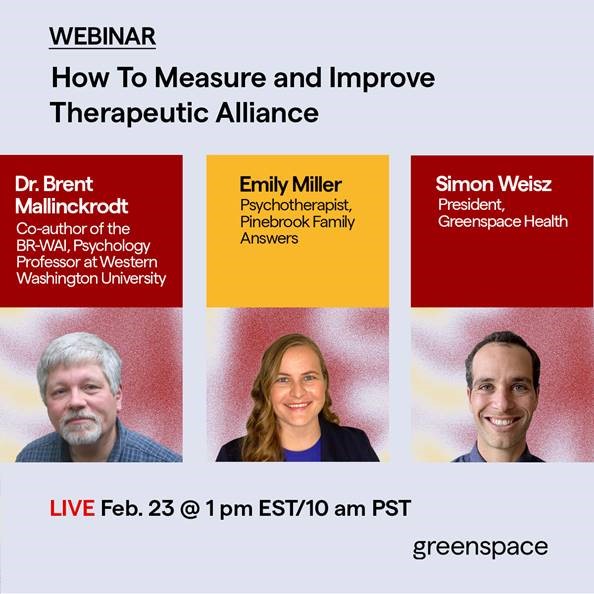
The team at Greenspace Health is hosting their third and final educational panel with the researchers and renowned psychologists at the Yale Measurement-Based Care Collaborative. You won’t want to miss this session with The Collaborative— it’s your chance to build on your knowledge of MBC and learn from the researchers driving its momentum.

Greenspace is excited to invite you to this live Q&A session with the Yale MBC experts to build on your knowledge of MBC and learn from those driving its momentum. Over 650 clinicians and clinical leaders attended the first two sessions. You won’t want to miss this event!

ASK ME ANYTHING: A Measurement-Based Care Q&A With the Experts at Yale is coming up on November 3 at 1:00 pm EDT. Visit here to register now! Greenspace hopes you can make it, and please feel free to share the event with anyone on your team.

Watch this short video for highlights from the last panel!