


MLTSS Association to Hold Webinar on “Unlocking the Value of Enabling Technology in Managed LTSS” March 12



ADvancing States, which represents the nation’s 56 state and territorial agencies on aging and disabilities as well as long-term services and supports directors, has partnered with the Department of Health Policy and Management at UNC Gillings School of Global Public Health to create a first-of-its-kind online training program to support our nation’s Home and Community-Based Services (HCBS) program workforce. The initial Foundational Leadership in HCBS: Building Expertise to Better Support People in their Homes and Communities certificate program launches in September 2025.
The core training sessions deliver essential curriculum covering HCBS systems, policies, and operations — everything participants need to enhance their effectiveness and advance policy advocacy in this critical sector. Fewer than 20 spots remain in the September pilot session, and there will be another session offered in January 2026. The course fee is $600 for government and non-profit employees and $1300 for corporate employees. Group registration opportunities are expected to be available for the January 2026 session.
Quick Registration Links:
The course is offered exclusively online and is self-paced so learners can set their own schedules, but the course will require the equivalent of about two hours per week for 10 weeks. Participants will learn more about populations utilizing LTSS, the organizations and individuals providing LTSS, and the varied sources of funding for LTSS, with a focus on HCBS, plus key policy areas, including the Older Americans Act, the Americans with Disabilities Act, Medicare, Medicaid, and the processes by which individuals access services. Please view the Course Overview and Syllabus for additional details about course topics and learning objectives.
Sign up using the links above; for questions about the HCBS Certificate program, contact Annie Kimbrel via email.





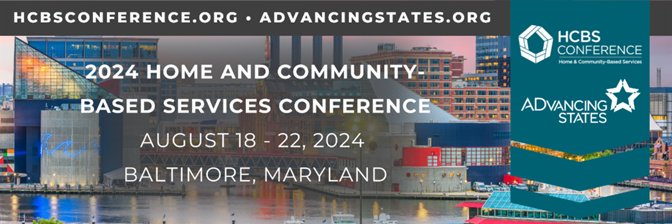
ADvancing States invites you to register for the 2024 Home and Community-Based Services (HCBS) Conference, celebrating significant milestones this year: the 60th anniversary of ADvancing States and the 40th anniversary of the HCBS Conference. The event gathers leaders and policymakers in the field of aging and disabilities to discuss and share practices that enhance state systems delivering long-term services and supports for individuals of all ages and abilities. Scheduled from Monday, August 18, to Friday, August 22, 2024, at the Baltimore Marriott Waterfront, the conference offers over 190 sessions, along with breakfast, lunch, and networking opportunities, including a Gala Dinner on Wednesday, August 21. Additionally, a virtual conference will be available on Wednesday, September 11, and Thursday, September 12, featuring on-demand sessions with live speaker Q&A, accessible from home at a reduced rate. For more details or to register, visit the in-person registration or virtual conference information pages.
ADvancing States and the ARPA HCBS TA Collective Announce Release of Report Summarizing State Experiences with ARPA HCBS Initiatives
FOR IMMEDIATE RELEASE
April 23, 2024
CONTACT: Camille Dobson
202-898-2578
ARLINGTON, VA — ADvancing States and our partners in the American Rescue Plan Act (ARPA) home and community-based services (HCBS) Technical Assistance Collective (TA Collective) are proud to release a report sharing findings about states’ experience in implementing their ARPA HCBS initiatives. While the ARPA infusion of federal dollars into HCBS provided an historic opportunity to try bold, new approaches to supporting people in their homes and communities, states were challenged to make systemic improvements given the time-limited nature of the federal funds.
To gather insights into states’ experiences in implementing their ARPA HCBS spending plans, the TA Collective fielded a national survey in early 2024 that aimed to identify successful strategies used by states implementing their ARPA HCBS spending plans, as well as any barriers hindering their success. Based on responses to that survey, this report highlights the challenges and barriers states faced in thoughtfully executing their initiatives in the midst of a public health emergency. The thirty-three states that responded to the survey shared the top barriers to implementing their projects as planned. These barriers include:
The report also suggests ways to make any future time-limited investments in the HCBS system more effective, including giving states more time to implement, easing the CMS approval process and providing resources to both states and CMS. Moreover, any future investments should be accompanied by a federal evaluation to glean insights into successful interventions that could be replicated across the country.
While this report highlights challenges and lessons learned, it should be noted that, against all odds, states created transformational change with their ARPA spending plan initiatives. Our hope is that this report — and the recommendations contained therein — serves as a roadmap for any future federal investment in the HCBS system.
This report is also informed by the TA Collective’s work supporting states with their ARPA initiative planning, implementation, and evaluation activities and by observations and analysis of state and federal ARPA HCBS activities. It builds upon the TA Collective’s past work including, Efforts to Evaluate the Impact of ARPA HCBS Investments, an issue brief examining state evaluation approaches, and a summary of the work of the HCBS Sustainability Summit, which provided valuable context on sustaining the HCBS commitment fostered by ARPA investments. Both reports can be found here.
We are grateful to The John A. Hartford Foundation, the Care for all with Respect and Equity (CARE) Fund, The SCAN Foundation, and the Milbank Memorial Fund for their support in making the work of the TA Collective possible.