





';
Tags Posts tagged with "Advocacy"

Advocacy

0 1260
Harrisburg, USA - May 24, 2017: Pennsylvania capitol interior dome colorful ceiling in city with American Flags

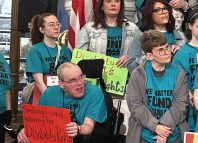
Join RCPA for our 2025 Capitol Day, which will be held Wednesday, March 26. Don’t miss out on this opportunity to advocate for yourselves and those you serve by meeting with legislators directly! We will hold a press conference in the Main Rotunda between 10:00 am – 11:00 am. The following legislators and leaders in the Health and Human Services arena will be speaking:

  • Richard S. Edley, PhD, President/CEO, RCPA;
  • Fady Sahhar, MBA, PhD, Director, Physical Disabilities & Aging Division, RCPA;
  • Melva Fair, CEO, Community Living and Support Services;
  • Annie Smith, Director of Early Intervention, Strawberry Fields;
  • Representative Doyle Heffley (R-Carbon);
  • Representative Joseph Hohenstein (D-Philadelphia);
  • Senator Michele Brooks (R-Crawford/Lawrence/Mercer); and
  • Senator Tim Kearney (D-Delaware).

If you haven’t done so yet, you can register for our Capitol Day press conference by contacting Christine Tartaglione. Please let us know if additional staff or colleagues within your organization are planning to attend Capitol Day with you.

RCPA requests that members schedule appointments with their Senate and House legislators directly to discuss the state budget, legislation, and regulations after our press conference. If you have scheduled meetings, please contact Jack Phillips with details, as we can provide some level of coordination. RCPA will provide policy specific materials at the rally, including the RCPA 2025 Legislative Priorities.

As an additional resource, members can visit the Pennsylvania Capitol website to locate parking and view maps of the building. If you have questions regarding our 2025 Capitol Day, please contact Jack Phillips.

Join RCPA for an afternoon of golf on Tuesday, May 13, 2025. The event will be held in support of the RCPA PAC and take place at the Colonial Golf & Tennis Club in Harrisburg, PA. Lunch will be at 11:30 am, with a shotgun start at 1:00 pm. Register to attend today!

We hope you will consider becoming a sponsor in support of this fundraiser! Sponsorship will allow your company to receive name recognition, and we’re excited to have even more opportunities to showcase your company this year. We hope we can count on your support for this event.

Not a golfer but would still like to support the RCPA PAC? For your convenience, you can now make a personal online contribution, which will provide financial support to state legislators or representatives who have demonstrated a strong, consistent, and positive interest in our legislative priorities. If you are interested in learning more about the RCPA PAC or donating, please visit our website or email Jack Phillips, Director of Government Affairs.

We look forward to seeing you on the golf course!

The Republican-controlled U.S. House adopted a federal budget resolution last week that instructs the House Energy and Commerce Committee, which has jurisdiction over Medicaid, to identify at least $800 billion in mandatory spending cuts during the next 10 years. The resolution is now in the GOP-controlled U.S. Senate.

Medicaid, which is jointly funded by states and the federal government through a federal matching program with no cap, is seen as a prime target for cuts, as it is one of the largest federal programs at a cost of more than $600 billion a year. Approximately 70 million people in the United States receive Medicaid benefits, with about 3 million — including 1.2 million children — of those in Pennsylvania. While officially the federal government did not name Medicaid as the target, there are virtually no other areas to turn to in order to generate such spending cuts.

Proposals being considered in Congress to cut Medicaid are estimated to cost Pennsylvania as much as $2 billion a year. These cuts will inevitably result in:

  • Fewer insured Pennsylvanians;
  • Fewer covered services for those who remain insured;
  • Lower reimbursement rates paid to providers;
  • Increases in uncompensated care; and
  • Higher healthcare costs for those who are insured.

In addition to broad, negative consequences, each segment of the human services sector will be affected.

Behavioral Health

Medicaid is the largest payer of behavioral healthcare services in the United States, where nearly 40 percent of non-elderly adult Medicaid beneficiaries have a mental health or substance use disorder. Additionally, Medicaid is an essential revenue source for behavioral healthcare organizations. With the potential of fewer covered individuals and lower reimbursement rates, access will be squeezed, with existing providers less incentivized to accept Medicaid patients.

These potential cuts come on the heels of a compromised post-public health emergency unwinding of Medicaid, in which Pennsylvania’s actuarial analysis for the behavioral health capitation was severely underestimated. The eventual Medicaid rolls included more individuals with acute and chronic conditions, resulting in higher levels of care and services. Despite mid-year adjustments to the HealthChoices’s primary contractors, Pennsylvania will start the new fiscal year with the need to increase its BH Medicaid capitation by nearly $640 million.

Intellectual and Developmental Disabilities

Medicaid is the primary funding source for IDD services. If the proposed multi-billion dollar funding cuts occur, Pennsylvania’s intellectual disability system will face serious consequences, including service reductions, longer waitlists, and limited access to essential care. Providers already under strain may have to discharge individuals from community-based services, potentially returning them to institutional settings and undoing decades of progress towards independence and inclusion.

Pediatric Rehabilitation

Medicaid is a key funding source for healthcare and rehabilitation services for infants, children, and adolescents living with disabilities and medical complexity. Even for families with a private primary insurance, Medicaid as a secondary insurance fills in the gaps in covered care. Children with disabilities, regardless of household income, are Medicaid eligible to offset the high costs of care. Medicaid cuts will negatively impact the most vulnerable in our state: children with disabilities and special health needs.

Early Intervention

Medicaid is a supplemental funding source for Early Intervention services in Pennsylvania. All Pennsylvanian families currently enjoy access to these crucial home- and community-based services with no cost-share. Cuts in funding to this program may cause tighter eligibility requirements or cost-shares for families, ultimately decreasing access to essential services.


How the Cuts Might Be Done

Work Requirements

At this point, work requirements appear to be one of the most likely paths to Medicaid cuts.

According to the Pennsylvania Health Access Network (PHAN), approximately 1 million adults in Pennsylvania would be subject to the work requirement.

Medicaid work requirements would require certain Medicaid enrollees to work, look for work, or conduct another qualifying activity (e.g., education, caretaking) as a condition of receiving health insurance. As part of such a requirement, all working age Medicaid enrollees may be required on a monthly basis to report their work or verify their eligibility for an exemption because they are in school or a job training program, caring for others, or disabled/in treatment. Failure to do so would result in them losing Medicaid coverage.

On the surface, increasing support for work requirements is understandable. Able-bodied citizens on Medicaid who can work, should work. What is not being discussed is the fact that most of these individuals are already working but at an income that still qualifies them for Medicaid. Further, studies from states that have attempted to implement a Medicaid work requirement show that the cost to the state to implement and administer such a requirement is in the tens of millions of dollars.

If work requirements become a reality, advocates must lobby for waivers for special populations.

Federal Medical Assistance Percentage (FMAP)

At this point, according to Speaker of the U.S. House Mike Johnson, FMAP (as well as per-capita caps, see below) are not a consideration for reducing Medicaid spending.

Each state’s FMAP determines its federal share of Medicaid funding. FMAP is a formula that uses the state’s most recent three-year average per capita income data to provide higher matching rates to states with lower per capita incomes relative to the national average. FMAPs have a statutory minimum of 50 percent and a maximum of 83 percent.

In Pennsylvania, 56 percent of Medicaid costs are paid with federal dollars, leaving Pennsylvania to cover the balance.

Under the Affordable Care Act’s Medicaid Expansion, the FMAP for what became the newly eligible population — mostly low wage workers who do not have coverage through an employer, disabled workers, caregivers to children or elderly family members, and students — is fixed at 90 percent federal funding, with the commonwealth paying for the balance.

Per Capita Caps

A per capita cap funding arrangement sets an upper limit on federal payments per Medicaid enrollee in each eligibility group. In an aggregated cap (also called a capped allotment) approach, states receive federal matching funds up to a determined maximum. If the cap is exceeded, the state bears 100 percent of that cost with no federal match.


Resources

There are many resources continually being developed and distributed. These include ways to take immediate action with Congress. The following are some of the most relevant to our membership.


Next Steps

RCPA will continue to closely monitor the issue. As Congress’s next steps become clearer, we will work with our partners, including you, to develop and execute strategies to stop Medicaid cuts or minimize the negative effects.

Contact your respective RCPA Policy Director with questions.

0 1286

The Rehabilitation and Community Providers Association Political Action Committee (RCPA PAC) is asking members to consider making a personal contribution to the PAC. With these donations, we have been successful in supporting legislative leadership who understand the severe challenges facing many of our providers. These representatives are willing to stand up for our issues as we fight to move Pennsylvania forward.

We urge you to view our 2025 Legislative & Administrative Priorities to see how RCPA is and will continue to work for you. We are able to achieve these goals thanks to our members’ dedication and contributions.

Make an online contribution and advocate for yourself today. While the request is voluntary, we encourage you to make a contribution of $100, $250, $350, $500, or more to the RCPA PAC. If you are interested, you can also consider making a recurring monthly donation.

If you have any questions regarding the RCPA PAC or making a donation, please contact Jack Phillips, Director, Government Affairs.

Dear ANCOR Members,

Next week, some Members of Congress will be back in their districts, making it the perfect time to meet with them and urge them to protect Medicaid funding for home and community-based services (HCBS).

The newly released House budget framework calls for 1.5 trillion in cuts over ten years and directs the House committee with jurisdiction over Medicaid to cut at least $880 billion in spending. While the details have not yet been finalized, these reductions would likely result in deep cuts to Medicaid funding. Even if proposals do not specifically target funding for I/DD services, the resulting pressure on state budgets from Medicaid cuts creates an elevated risk of further limits and cuts to services for individuals with I/DD. In-district meetings and site visits are some of the most effective ways to educate lawmakers and their staff on how these cuts would harm people with intellectual and developmental disabilities (I/DD), providers, and families.

To help you prepare, we’ve put together key advocacy resources, including:

Why Your Action Matters:
Studies show that constituent messages are the most effective way to influence lawmakers. When they see firsthand the impact of Medicaid-funded services in their communities, they are far more likely to protect funding.

Take this opportunity to reach out to your Members of Congress while they’re home next week or check their website for an email list signup to make sure you don’t miss any opportunities to engage while they are home — let’s make sure they understand why Medicaid funding must be protected.

Thank you for your advocacy.

Message from ANCOR:

ANCOR shares their new Medicaid Resource Center for targeted resources to aid in your education and advocacy efforts! Let’s work together to protect Medicaid funding from potential cuts!

The Medicaid Resource Center is a central location where you can find the most up-to-date information and resources. Included in the Medicaid Resource Center is a video Intro to I/DD Services, ANCOR’S most recent fact sheet Cuts to Medicaid Harm Disability Services, as well as highlighted reports and white papers on Medicaid trends and impacts of community-based services. In addition to the Advocacy Toolkit and the ANCOR Amplifier, please use these targeted resources available in the new Medicaid Resource Center to aid in your advocacy.

As a reminder, you can also still take our action alert urging your Senators and Representatives to reject any proposals that reduce federal Medicaid funding! Thank you and please do not hesitate to reach out if they can help in your outreach!

Lydia Dawson, JD
ANCOR | Vice President of Government Relations
571-932-5375