



RCPA Shares Updates on DHS H.R. 1 Committee, Eligibility, and SNAP Requirements



As the Pennsylvania Department of Human Services (DHS) prepares for the upcoming changes in the federal Medicaid standards set for implementation in January 2027, DHS has convened a statewide HR1 Steering Committee. This group is tasked with reviewing policy and practice drafts from the Department as it relates to their response to the pending Medicaid changes, including new eligibility and work requirements for recipients and communicating the implementation of Pennsylvania’s overall plan.
The steering committee is comprised of state leadership, advocates, and payers. RCPA providers will be represented by RCPA President and CEO Richard Edley. RCPA’s involvement will bolster our role as a lead advocate for members and stakeholders as it relates to Medicaid HR 1 activities. Additionally, RCPA has contracted with former Pennsylvania Medicaid Director Leesa Allen to assist in developing our internal strategies and advocacy platform.
The steering committee had its initial meeting yesterday, March 5, 2026, to lay out the groundwork for the group and presented an initial PowerPoint presentation that looks at some of the foundational information around Medicaid, CHIP, and SNAP changes.
If you have questions or feedback, please contact your respective RCPA Policy Director or COO Jim Sharp.
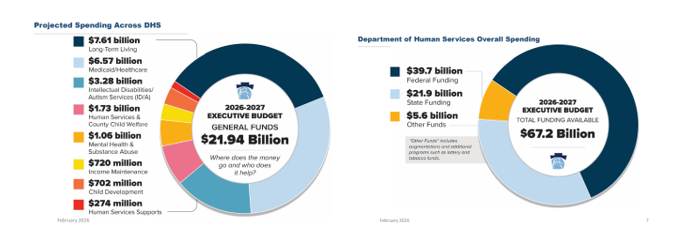
On Friday, February 6, Department of Human Services (DHS) Secretary Val Arkoosh presented an overview of Governor Shapiro’s proposed Fiscal Year (FY) 2026/27 budget and detailed the projected spending across DHS, which totals $21.94 billion in state funding. The Secretary highlighted that all three Medicaid managed care programs, as well as waiver programs for people with intellectual disabilities and autism, are receiving increases, largely driven by patient needs and costs associated with delivering care. The proposed FY 2026/27 budget includes $39.7 billion in federal funding as well as $5.6 billion from augmentations and additional programs, such as lottery and tobacco funds, making the total DHS funding $67.2 billion.
The Secretary expressed how the proposed budget reflects the direct impacts of HR 1, with significant federal funding at risk. The distribution for the 2026/27 budget is based upon the current structure of Medicaid and other federally funded programs, but the Secretary noted that beginning in 2028, changes in Medicaid financing rules will remove $20 billion from Pennsylvania’s Medicaid program over the following decade.
Budget Highlights and Investments
Due to technical difficulties, DHS was unable to record the webinar, but the presentation slides and transcript can both be viewed.
Please contact your RCPA Policy Director with any questions or concerns.


REMINDER — PLEASE DISREGARD IF YOU HAVE ALREADY COMPLETED THIS SURVEY
Pennsylvania’s General Assembly has not yet passed the budget for FY 2025/26, and we are already two months into this fiscal cycle. This delay is creating another crisis while communities grapple with the longer-term implications of the recently passed HR 1 Tax Reconciliation Bill at the federal level. We want to hear from you via this 2025 Budget Impasse Survey so that we can raise a collective nonprofit clamor about the impact this delay has on real people in every neighborhood and community in the Commonwealth.
We know — our organizations are over-surveyed during times of urgency!
So, to eliminate duplicative work, various associations and networks, including RCPA, have come together to collect data regarding both the current and projected impact on both for-profit and nonprofit financials, staffing, and ultimately those served. We will share information with everyone involved so that the survey results can be analyzed and disseminated to the media and legislative contacts most efficiently. Below are the organizations that are coming together to collect this data in order to show you the importance of this information.

For more details about the length of the survey and those best suited to complete it, please see this PDF version so you can prepare. The initial survey deadline is 11:59 pm on Monday, September 15, 2025. For questions about the survey, please email Anne Gingerich, Executive Director, PANO.
We want to hear from your organization via this 2025 Budget Impasse Survey so that we can highlight the impacts this delay has on real people in every neighborhood and community in the Commonwealth.
We will share information with all parties involved so that the survey results can be analyzed and disseminated to the media and legislative contacts most efficiently. Below are the organizations that are coming together to collect this data in order to show you the importance of this information.
The initial survey deadline is 11:59 pm on Monday, September 15, 2025.
For questions about the survey, please email Anne Gingerich, Executive Director, PANO.

A new Center for American Progress (CAP) analysis estimates that if H.R. 1 were to become law, more than 1.6 million Medicaid-expansion enrollees receiving SUD treatment would become uninsured. Although these estimates reflect the House-passed bill, the Senate’s more extreme Medicaid cuts could cause even greater coverage losses and disruptions to care.
KFF developed a table that provides a summary comparison of Medicaid provisions, including details on work requirements, in the House and Senate budget reconciliation bills.
The reconciliation legislation still needs to pass the Senate, and the House and Senate will need to reconcile any outstanding differences. President Trump expects to have the reconciliation bill on his desk for signing by July 4.
The bulk of those coverage losses would come from the bill’s proposed burdensome work-reporting requirements on adults enrolled in Medicaid through the Affordable Care Act’s expansion option. Specifically, the bill would require nonpregnant, nondisabled, non-caregiver adults ages 19 to 64 to document at least 80 hours of work per month or other qualifying activities (such as job training or volunteering) in order to maintain their Medicaid coverage. Individuals unable to meet the requirement would risk losing coverage. The Senate Finance Committee text goes even further, eliminating the exemption and requiring compliance from parents with children older than age 14.
Though the bill includes an exemption for individuals with SUD from work-reporting requirements, it remains unclear how states would implement or enforce that exemption.
CAP estimates that the states with the largest coverage losses among Medicaid enrollees being treated for SUD include California (nearly 170,000), New York (nearly 166,500), Ohio (134,500), and Pennsylvania (nearly 118,000). These coverage losses reflect the size of each state’s Medicaid expansion population as well as each state’s rate of SUD treatment take-up among people with Medicaid.
Medicaid is the largest payer of behavioral health services in the United States, including for SUD treatment. According to the latest available data, Medicaid covered nearly 60 percent of all national spending on SUD treatment in 2019 — accounting for $17 billion out of the $30 billion spent across all payers.
ACA improved SUD treatment access by making SUD services one of ten essential health benefits that nearly all insurers are required to cover. The ACA also allowed states to expand Medicaid eligibility to adults with incomes up to 138 percent of the federal-poverty level, providing millions of previously uninsured low-income adults with access to life-saving SUD treatment.