






';
Tags Posts tagged with "Rural Care Collaborative"

Rural Care Collaborative

Photo by Markus Winkler on Unsplash

Friday, April 10 at 5:00 pm is the deadline to complete and submit nominations for the Rural Health Transformation Plan (RHTP) Advisory Council and RHTP Rural Care Collaboratives (RCC).

Advisory Council (Statewide): This is a not a decision-making body.
The Advisory Council will provide subject matter expertise (SME) to the RCCs. The Council’s feedback is intended to inform and enhance RCC regional plans to ensure planned projects have the best chance of succeeding and will be sustainable after the 5-year RHTP funding is no longer available.

  • Meeting Cadence: The Advisory Council will meet once a month during the RCC plan development period. Once plans are solidified, the Advisory Council will meet quarterly to help address implementation concerns.
  • Council Member Expectations: Provide technical assistance (TA) to the RCCs in the member’s identified area of expertise. TA can be provided in multiple formats. This could be open discussion during RHTP meetings, written questions and answers, or a more hands-on knowledge transfer.
  • Conflict of Interest: If chosen for the Advisory Council, members must provide their formal CV for documentation, a brief bio, and disclosure of any conflicts of interest. All conflicts of interest also must be communicated verbally during meetings and TA communication with RCCs.

The Advisory Council needs SME representation in:

  • Aging and Access
  • Behavioral Health
  • EMS and Transportation
  • Technology and Infrastructure
  • Maternal Health
  • Workforce

Rural Care Collaboratives (Regional): This is a planning body.
There will be 8 RCCs established with the purpose of:

  • Identifying regional priorities based on healthcare gaps;
  • Developing a regional plan to address prioritized needs; and
  • Recommending/identifying projects to the RHTP interagency project team to operationalize the regional plan that works towards Pennsylvania’s identified outcomes.

Complete the RHTP Advisory Council and RCC Nomination form here.
The Department of Human Services (DHS) has launched a new website for the PA Rural Health Transformation Plan, containing information on goals as well as links to the full plan and news updates.

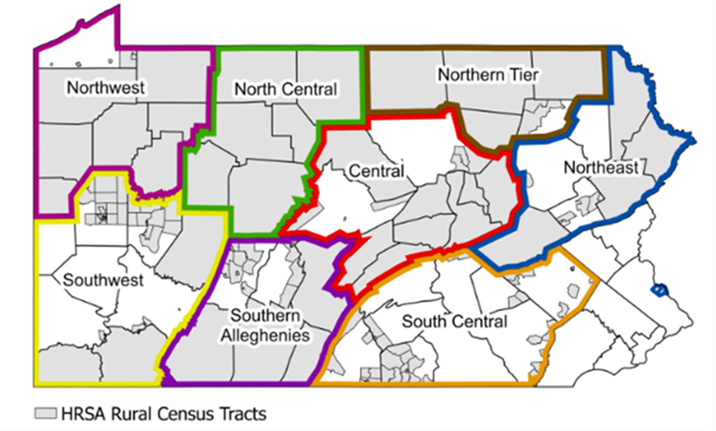
While a formal RFP process has not yet been released, providers can submit the following inquiry form. This brief survey provides each organization with an opportunity to introduce your agency and services you offer, ask questions regarding the Rural Health Transformation Plan, and identify the Rural Care Collaborative region(s) where you and/or your organization is based or provides services (see map below). Once submitted, DHS will review and respond to your inquiry as soon as possible.


Providers and stakeholders may also sign up for updates on the Rural Health Transformation Plan.

If you have any questions, please contact RCPA COO Jim Sharp.

From Pennsylvania Capital-Star “Pa.’s Rural Health Application Reveals Priorities in Federal Funding Request,” November 20, 2025:

Pennsylvania is hoping to secure its own slice of a $50 billion rural health fund in the face of federal Medicaid cuts, with a focus on bolstering a beleaguered workforce and expanding health access for more than two million people.

The Rural Health Transformation Fund was a last-minute addition to President Donald Trump’s summer budget bill that imposed Medicaid work requirements and cut upwards of $51 billion in funding to the commonwealth over the next decade. That new fund is worth roughly 37% of the estimated lost Medicaid funding in rural areas

The 67-page application requests up to $200 million in annual funding over the next five years, totaling $1 billion. Its six focuses include: technology and infrastructure, workforce, maternal health services, behavioral health services, aging and access, and emergency medical services and transportation.

The U.S. Department of Human Services is expected to award funding by the end of the year.

Key objective targets are:

  • Access to care: More than 85% of Pennsylvanians can get a routine primary care appointment within four weeks and urgent care appointments within one week.
  • Digital connectivity and telehealth: More than 85% of rural hospitals and clinics will have broadband and telehealth functionality. More than 50% of rural hospitals and clinics connected via Fast Healthcare Interoperability Resources.
  • Workforce adequacy: Reduce rural hospital vacancy rates by 10% for key direct care roles. Add three new rural training programs.
  • System sustainability: More than 60% of systems partnered with rural Community Health Centers for specialty care.
  • Health outcomes: Reduce the number of pregnant women living in rural areas with inadequate prenatal care by 20%.

From the PA Rural Health Transformation (RHT) Program Application:

Pennsylvania’s rural health transformation strategy is grounded in a balance of statewide coordination and regional leadership and collaboration. Pennsylvania’s “Health Hub” state agencies (Human Services, Health, Aging, Insurance, Drug and Alcohol Programs), and other partner agencies will establish clear strategic priorities focusing on access, workforce, maternal health, aging, behavioral health, EMS and infrastructure. Pennsylvania will leverage statewide technical expertise, evaluation, and financial oversight and support. Strong regional rural care collaborative will be composed of a roster of regional stakeholders that prioritize local needs, develop effective local sustainable solutions, and leverage existing resources and assets.

Pennsylvania will leverage established regional entities that coordinate regional economic development. These Partnerships for Regional Economic Performance (PREP) organizations are long-standing, quasi-governmental organizations that convene regional stakeholders, administer federal and state grants, collect local data, report outcomes, and catalyze public and private partnerships for regional economic development. They bring established governance structures, convening power, and a track record of successful cross-sector collaboration. PREPs (Figure 2) will convene regional stakeholders to create Rural Care Collaborative (RCCs) to align initiatives with regional economic planning and development – making the RHTP investments sustainable and promoting long-term partnerships.


If you have any questions, please contact RCPA COO and Mental Health Policy Director Jim Sharp.