';
Tags Posts tagged with "Rural Health"

Rural Health

From Pennsylvania Capital-Star “Pa.’s Rural Health Application Reveals Priorities in Federal Funding Request,” November 20, 2025:

Pennsylvania is hoping to secure its own slice of a $50 billion rural health fund in the face of federal Medicaid cuts, with a focus on bolstering a beleaguered workforce and expanding health access for more than two million people.

The Rural Health Transformation Fund was a last-minute addition to President Donald Trump’s summer budget bill that imposed Medicaid work requirements and cut upwards of $51 billion in funding to the commonwealth over the next decade. That new fund is worth roughly 37% of the estimated lost Medicaid funding in rural areas

The 67-page application requests up to $200 million in annual funding over the next five years, totaling $1 billion. Its six focuses include: technology and infrastructure, workforce, maternal health services, behavioral health services, aging and access, and emergency medical services and transportation.

The U.S. Department of Human Services is expected to award funding by the end of the year.

Key objective targets are:

  • Access to care: More than 85% of Pennsylvanians can get a routine primary care appointment within four weeks and urgent care appointments within one week.
  • Digital connectivity and telehealth: More than 85% of rural hospitals and clinics will have broadband and telehealth functionality. More than 50% of rural hospitals and clinics connected via Fast Healthcare Interoperability Resources.
  • Workforce adequacy: Reduce rural hospital vacancy rates by 10% for key direct care roles. Add three new rural training programs.
  • System sustainability: More than 60% of systems partnered with rural Community Health Centers for specialty care.
  • Health outcomes: Reduce the number of pregnant women living in rural areas with inadequate prenatal care by 20%.

From the PA Rural Health Transformation (RHT) Program Application:

Pennsylvania’s rural health transformation strategy is grounded in a balance of statewide coordination and regional leadership and collaboration. Pennsylvania’s “Health Hub” state agencies (Human Services, Health, Aging, Insurance, Drug and Alcohol Programs), and other partner agencies will establish clear strategic priorities focusing on access, workforce, maternal health, aging, behavioral health, EMS and infrastructure. Pennsylvania will leverage statewide technical expertise, evaluation, and financial oversight and support. Strong regional rural care collaborative will be composed of a roster of regional stakeholders that prioritize local needs, develop effective local sustainable solutions, and leverage existing resources and assets.

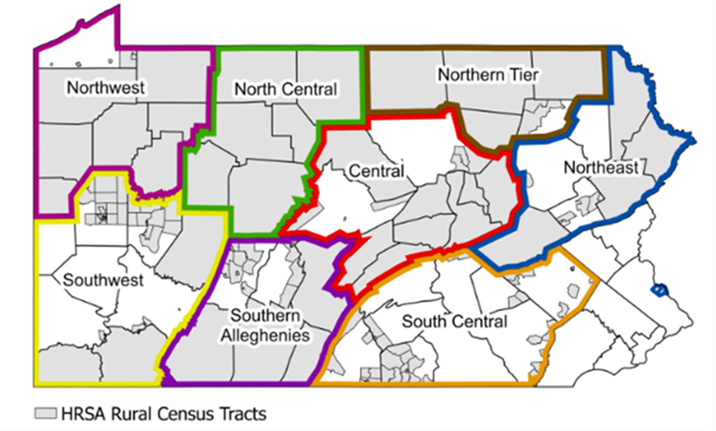
Pennsylvania will leverage established regional entities that coordinate regional economic development. These Partnerships for Regional Economic Performance (PREP) organizations are long-standing, quasi-governmental organizations that convene regional stakeholders, administer federal and state grants, collect local data, report outcomes, and catalyze public and private partnerships for regional economic development. They bring established governance structures, convening power, and a track record of successful cross-sector collaboration. PREPs (Figure 2) will convene regional stakeholders to create Rural Care Collaborative (RCCs) to align initiatives with regional economic planning and development – making the RHTP investments sustainable and promoting long-term partnerships.


If you have any questions, please contact RCPA COO and Mental Health Policy Director Jim Sharp.

Image by Dirk Wouters from Pixabay

Thank you for your participation in Pennsylvania’s rural health ecosystem, including those who attended a regional rural health summit. As a next step, DHS is gathering information, concepts, and additional ideas to shape the Commonwealth’s Rural Health Transformation Plan and reflect what they heard from rural providers, partners, and residents.

What DHS is asking for:

  1. Information and concepts in these summit-affirmed areas: Maternal Health, Mental and Behavioral Health, Aging and Access, Transportation and EMS, and the Rural Healthcare Workforce.
  2. Other ideas that improve access to care in rural communities, even if they fall outside those five areas.

Who can submit:

  • Hospitals and health systems;
  • Healthcare professionals;
  • FQHCs and rural health clinics;
  • State offices of rural health;
  • Grantees providing services in rural areas;
  • Healthcare leadership and administrators;
  • Healthcare consumers;
  • Community action organizations;
  • Public and private business owners and organizations;
  • EMS and transportation providers;
  • Behavioral health, aging, and disability services partners, county commissioners, and other local or state government representatives, single county authorities, economic development organizations, professional organizations, community-based and faith-based organizations, philanthropy, and higher education and health provider training partners; and
  • Other interested parties.

What to include:

Information to assist DHS in enhancing and transforming rural health, including core concepts, target problems, or opportunities for improvement, intended impact and success metrics, evidence or prior experiences, feasibility of ideas for rural settings, partners, costs and resources, innovation or adaptation, and sustainability.

Submit by: August 29, 2025
Find the Form Here
Questions or Accessibility Needs: Email

DHS may use the information gathered through this process in the development of future implementation; however, the Departments do not guarantee that this will occur.

Respondents should be aware that the responses will be public information and that no claims of confidentiality will be honored. DHS is not requesting, and does not require, confidential, proprietary information, or other competitively sensitive information to be included as part of a submission. Ownership of all data, material and documentation originated, prepared, and provided to the Departments during this process will belong exclusively to the Departments.


Please contact your RCPA Policy Director with any questions.

H.R. 1 created a $50 billion fund called the Rural Health Transformation program in an attempt to offset the losses that rural health providers will experience associated with the other devastating cuts to health care in the legislation.

Each state must complete a one-time application for the five-year program to be reviewed by CMS. Many aspects of the application are still undecided, including the submission period, due date, state entity that must submit the application, and the form of the application. The RHTP application must include a plan to describe how the state would use the funds to:

  • Improve access to hospitals and other providers for rural residents;
  • Improve health care outcomes of rural residents;
  • Prioritize the use of new and emerging technologies that emphasize prevention and chronic disease management;
  • Initiate, foster, and strengthen local and regional strategic partnerships between rural hospitals and other providers to promote quality improvement, increase financial stability, maximize economies of scale, and share best practices;
  • Recruit and retain clinicians,
  • Prioritize data and technology driven solutions that help rural providers furnish health care services as close to the patient’s home as possible;
  • Outline strategies to manage long-term financial solvency and operating models of rural hospitals; and
  • Identify specific causes that are driving standalone rural hospitals to close, convert, or reduce service lines.

The funds will be distributed between 2026 and 2030, allotting $10 billion each year. $25 billion of this fund will be allocated equally among all states with an approved application by CMS. Assuming that all fifty states are approved, each state will receive a minimum of $100 million per year for five years. The other $25 billion will be distributed to states with an approved application in an amount determined by CMS based upon the state’s rural population, proportion of healthcare facilities in rural areas, and the situation of hospitals that serve a high proportion of low-income patients.

The bill lists several allowable uses of the PHTP funds:

  • Promoting evidence-based, measurable interventions to improve prevention and chronic disease management;
  • Providing payments to health care providers for the provision of health care items or services as specified by CMS;
  • Promoting consumer-facing, technology-driven solutions for the prevention and management of chronic diseases;
  • Providing training and technical assistance for the development and adoption of technology-enables solutions that improve care delivery in rural hospitals, including remote monitoring, robotics, artificial intelligence, and other advanced technologies;
  • Recruiting and retaining clinical workforce talent to rural areas, with commitments to serve rural communities for a minimum of five years;
  • Providing technical assistance, software, and hardware for significant information technology advances designed to improve efficiency, enhance cybersecurity capability development, and improve patient health outcomes;
  • Assisting rural communities to right-size their healthcare delivery systems by identifying needed preventative, ambulatory, pre-hospital, emergency, acute inpatient care, outpatient care, and post-acute care service lines;
  • Supporting access to opioid use disorder treatment services, other substance use disorder treatment services, and mental health services;
  • Developing projects that support innovative models of care that include value-based care arrangements and alternative payment models as appropriate; and
  • Additional uses designed to promote sustainable access to high quality rural health care services, as determined by the Administrator.

RCPA will continue to share information on the program and applications as it becomes available. Contact Emma Sharp with any questions.