



ODP Shares April 2026 ISAC Materials



Governor Shapiro has made student mental health a priority, investing nearly $400 million in school-based mental health and school safety since January 2023. The proposed 2026/27 budget includes a continued investment of $111 million for school safety and mental health supports, with $100 million of these funds allocated through the Pennsylvania Commission of Crime and Delinquency (PCCD) as a non-competitive grant.
Student mental health continues to be the largest instructional challenge in schools, with more than 80% of school districts reporting that a shortage of qualified mental health care providers is the biggest challenge in connecting students to the care they need. Despite significant investments, why can students not access the mental health care they require to thrive?
The Rehabilitation and Community Providers Association (RCPA) and the Mental Health Safety Net Coalition members urge the Pennsylvania General Assembly to consider these blueprint recommendations. Never before have we had the opportunity to fund and act so decisively.
The full letter can be read here.
The Mental Health Safety Net Coalition is a group of stakeholders participating in a joint advocacy effort to protect and preserve our mental health service delivery system. RCPA invites all members, non-members, and systems-wide behavioral health stakeholders to participate in the Mental Health Safety Net Coalition meetings that will be occurring throughout the budget season.
The next Mental Health Safety Net Coalition meeting is scheduled for Wednesday May 6, 2026, at 1:00 pm. Please contact Emma Sharp with any questions or if you would like to join the Coalition.
The Department of Human Services (DHS) recently announced that Governor Shapiro signed three new executive orders (EO) to benefit people with disabilities. The following information comes from the Office of Long-Term Living:
The first Executive Order rescinds and replaces EO 2002-5 and will protect the rights, dignity, and privacy of people with disabilities by reaffirming the Commonwealth’s longstanding nondiscrimination commitment and emphasizing the need that these protections require renewed attention and action, not just compliance. This order will ensure data collection by Commonwealth agencies is limited to the minimum data necessary and proper processes are followed by Commonwealth agencies, including collection in health care, research, and compliance in the law.
The Governor’s second Executive Order rescinds EO 2006-09 and EO 2016-03 and establishes the Governor’s Advisory Commission on People with Disabilities, which will consist of up to 30 volunteer members, appointed by the Governor, including individuals with disabilities, family members, or those with relevant expertise. The members will serve two-year terms. The new commissioners will recommend policy changes across the disabilities spectrum, engage with federal/state/local agencies, communicate Administration initiatives to the public, and compile information on programs, funding, and additional supports to create an inclusive resource for individuals with disabilities and their family members across Pennsylvania.
Individuals interested in the Governor’s Advisory Commission on People with Disabilities Executive Director position, may apply here or by visiting the Commonwealth of PA – Opportunities for All Job Seekers page.
The third Executive Order rescinds EO 1997-2 and reestablishes the Development Disabilities (DD) Council so that it can continue to fulfill Pennsylvania’s obligations under the federal Developmental Disabilities Act. The independently operated DD Council is more narrowly focused than the newly-created Commission and will advise the Governor on all matters affecting individuals with developmental disabilities in Pennsylvania, and advocate for improved independence, productivity, and community inclusion. The Council will continue to develop and implement a statewide plan and advocate for systemic change across the Commonwealth.
More information about the Governor’s press release and the three new Executive Orders can be found on the Commonwealth of Pennsylvania Newsroom page.


The Mental Health Safety Net (MHSN) Coalition is a group of stakeholders participating in a joint advocacy effort to protect and preserve our mental health service delivery system. The Coalition’s first advocacy bulletin discusses the critical areas of funding for the FY 2026/27 budget, including community mental health, school-based services, crisis intervention services, Behavioral HealthChoices programs, and impacts associated with the implementation of H.R. 1.
The full letter can be read here.
RCPA invites all members, non-members, and systems-wide behavioral health stakeholders to participate in the Mental Health Safety Net Coalition meetings that will be occurring throughout the budget season. These meetings will serve to update the group on strategy, activities, and engagement opportunities.
Also note that the Mental Health Safety Net Coalition will also be participating in the RCPA Capitol Day on Wednesday March 25, 2026, with the event starting at 10:00 am in the Capitol Rotunda in Harrisburg.
Please contact Emma Sharp with any questions or if you would like to join the Coalition.

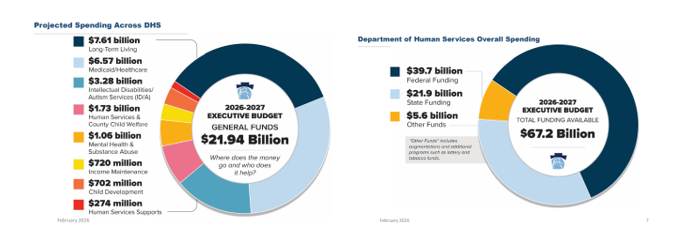
On Friday, February 6, Department of Human Services (DHS) Secretary Val Arkoosh presented an overview of Governor Shapiro’s proposed Fiscal Year (FY) 2026/27 budget and detailed the projected spending across DHS, which totals $21.94 billion in state funding. The Secretary highlighted that all three Medicaid managed care programs, as well as waiver programs for people with intellectual disabilities and autism, are receiving increases, largely driven by patient needs and costs associated with delivering care. The proposed FY 2026/27 budget includes $39.7 billion in federal funding as well as $5.6 billion from augmentations and additional programs, such as lottery and tobacco funds, making the total DHS funding $67.2 billion.
The Secretary expressed how the proposed budget reflects the direct impacts of HR 1, with significant federal funding at risk. The distribution for the 2026/27 budget is based upon the current structure of Medicaid and other federally funded programs, but the Secretary noted that beginning in 2028, changes in Medicaid financing rules will remove $20 billion from Pennsylvania’s Medicaid program over the following decade.
Budget Highlights and Investments
Due to technical difficulties, DHS was unable to record the webinar, but the presentation slides and transcript can both be viewed.
Please contact your RCPA Policy Director with any questions or concerns.
