
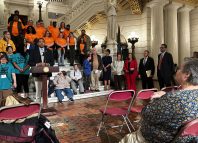
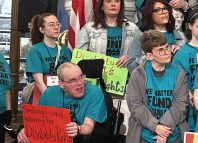



Gov. Shapiro Unveils PA Budget Plan That ‘Builds on Progress’ and Raids the Piggybank

The Pennsylvania Department of Drug and Alcohol Programs (DDAP) is awarding more than $1.2 million to expand access to recovery housing and recovery support services throughout Pennsylvania for young adults 18–24 years old who have opioid or stimulant use disorders. DDAP is awarding grants to nine Single County Authorities (SCA) to fund the effort.
Currently, there are about 430 DDAP-licensed recovery houses across the Commonwealth. The purpose of the Administration’s licensure program is to help empower sustained recovery for individuals with substance use disorder (SUD) by ensuring a network of safe drug and alcohol recovery houses. Drug and alcohol recovery houses are required to be licensed in order to receive referrals from state agencies or state-funded facilities or to receive federal or state funding to deliver recovery house services.
The grant funds will be used to supplement existing resources, ensuring that current services are expanded rather than replaced, and that recovery housing remains accessible and safe through Pennsylvania.
DDAP is awarding nine grants, which will run through September 30, 2026, to the following SCAs serving 14 counties:
RCPA will reengage with all members, non-members, and systems-wide behavioral health stakeholders to participate in the Mental Health Safety Net Coalition. The Coalition is focused on developing strategies, activities, and engagement opportunities to support behavioral health funding in the Commonwealth.
The Coalition will have its first meeting on Friday, February 13, 2026, from 12:00 pm – 1:00 pm. This meeting will give the group an opportunity to review last year’s budget, Governor Shapiro’s proposed budget, and initial strategies for the Fiscal Year (FY) 2026/27. It will also give us an opportunity to develop questions for legislators for the DHS budget hearings in late February and early March. Register for the meeting by contacting Emma Sharp, RCPA Policy Associate.
As the group continues to meet, we will develop our overall advocacy blueprint to ensure the communication of our message and stakeholder engagement is focused on protecting and preserving our mental health service delivery system.
The meetings will be held via Microsoft Teams; information will be sent to those interested in the Coalition. RCPA invites all to participate. If you would like to join the Coalition or have any questions, please contact Emma Sharp.


The Children’s Trust Fund (CTF) provides small grants to local community-based programs/services that prevent child abuse and neglect before an incident occurs. The Children’s Trust Fund (CTF) Request for Application (RFA) was posted on eMarketplace today, January 5, 2026. The press release is being shared through DHS comms, PA Key comms, and a special announcement in the e-News.
RCPA, as part of several statewide work groups and task forces, wishes to share this with members, though you may receive this through other communications networks. The RFA is only available for 30 days, due no later than February 5, 2026.
If an applicant has any questions regarding this RFA, the applicant must submit those questions via email, with the subject line “25-RFA-13772 Question” to the RFA Issuing Officer named in Part 1, Section I-2 of this RFA. The Issuing Officer shall post all written answers to the questions submitted on the Department of General Services (DGS) website at eMarketplace as an addendum to this RFA.
You may view the Request for Application online at eMarketplace.
Press release from the Centers for Medicare & Medicaid Services:
The Centers for Medicare & Medicaid Services (CMS) has announced that all 50 states will receive awards under the Rural Health Transformation Program, a $50 billion initiative established under President Trump’s Working Families Tax Cuts legislation (Public Law 119-21) to strengthen and modernize health care in rural communities across the country. In 2026, states will receive first-year awards from CMS averaging $200 million, within a range of $147 million to $281 million. This unprecedented federal investment will help states expand access to care in rural communities, strengthen the rural health workforce, modernize rural facilities and technology, and support innovative models that bring high-quality, dependable care closer to home.
Awardees and Funding Amounts
The Rural Health Transformation Program’s $50 billion in funds will be allocated to approved states over five years, with $10 billion available each year from 2026 through 2030. As directed by Public Law 119-21:
Read the full press release here.
Pennsylvania submitted their plan to CMS in November, and the plan is currently being evaluated. CMS made funding awards to all 50 states, with Pennsylvania receiving $193,294,054.
RCPA continues to work with the Department of Human Services (DHS) in answering questions from members as well as gaining an understanding on the implementation values for PA specific initiatives from both funding allocation pathways.
If you have any questions, please contact RCPA COO Jim Sharp.


The Pennsylvania Commission on Crime and Delinquency (PCCD), in partnership with the WestEd Justice and Prevention Research Center (JPRC), has received funding from the federal Office of Juvenile Justice and Delinquency Prevention (OJJDP) to develop a statewide Continuum of Care for Communities model for Pennsylvania. This initiative aims to provide actionable recommendations for diverting youth from the juvenile justice system toward community-based services and alternatives to detention.
To inform this statewide model, WestEd is seeking collaboration with Pennsylvania Juvenile Justice stakeholder groups to gather insights and evidence-based recommendations.
Their goal is to develop actionable recommendations for diverting youth from formal justice system involvement and to strengthen community-based services, drawing on the expertise and experience of local stakeholders. As someone involved in juvenile justice and juvenile justice-adjacent systems, your insights will be invaluable in shaping recommendations and identifying promising local practices.
What’s Involved: You are invited to join an engagement session to discuss:
Session Details:
Session Options
Your participation will not only contribute to improving outcomes for youth and families but also ensure that the report and recommendations reflect the needs and realities of your community.
If you are able to attend, please take 2–3 minutes to fill out the RSVP link connected to the session you wish to attend — please plan to attend one session. This will ensure you a spot and send you a calendar invite and Zoom link. Please feel free to share this email and flyer within any of your networks as well.
Lastly, if you have any questions, please reach out via email.
 Prev
Prev