

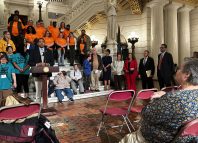


RCPA Member Vista Autism Services Awarded T-Mobile Hometown Grant to Enhance Learning Spaces for Students With Autism



The Office of Child Development and Early Learning (OCDEL) has released the outcomes from the Early Intervention (EI) Rate Methodology Study that concluded in the Fall of 2024. A key focus of the RCPA Early Intervention Steering Committee’s strategic agenda has been the review of how rates have been historically developed, including the lack of sustainable rate increases that have taken place over the past two decades. In our collaboration with OCDEL and other early intervention stakeholders, the goal was the development of a quantifiable rate methodology that uses the cost of care as a driving variable in the rate development matrix.
The EI Rate Study Final Report has been added to DHS website and can be viewed here. The study was the culmination of a year-long effort led the Public Consulting Group (PCG) and an Advisory Committee, which RCPA and other provider members were a part of.
The report reviewed the methodology and formulary variables for rate calculations across several operational dimensions of early intervention services, including staffing, operations, administration, and the calculation of how missed and cancelled visits intersect with actual costs.
The final funding review of the estimated Commonwealth fiscal impact was calculated using the number of service units provided during FY 2022/23 for Early Intervention services, current Federal Medical Assistance Percentage (FMAP), and county contributions. Services with a recommended rate decrease were kept at the current rate when calculating Commonwealth fiscal impact. The result indicated that for FY 2022/23, the rates were underfunded by more than $71M, or roughly 38% of the FY 2022/23 rate.
This year there is a proposed State budget increase of $10M that is targeted to aid Early Intervention providers in stabilizing their workforce infrastructure. This would be a 3% increase over the FY 2023/24 rate. There was no rate increase last year in anticipation of the rate methodology study report. There was hope that the study outcomes, which ended in September 2024, could have made a greater impact on this year’s projected rate increase. That notwithstanding, RCPA fully supports and will be advocating that the proposed $10M funding allocation be approved for Early Intervention services in the final budget. Additionally, there is a projected Medicaid allocation of $12.6M, for a total $22.6M that will go to the final rates for FY 2025/26.
Finally, the report indicated that between the periodic rate studies, PCG recommends that OCDEL implement a rate monitoring program to measure costs annually against payments. This monitoring should also measure inflation, and OCDEL should adjust rates annually to match the rate of inflation.
RCPA thanks OCDEL and our members for the partnership in the project and looks forward to the opportunity to work together in supporting and advocating the implementation of rates that support the cost of delivering high quality Early Intervention services to the children and families of the Commonwealth.
If you have any additional questions, please contact RCPA COO Jim Sharp or IPRC Policy Director Cindi Hobbes.


The PA Department of Health’s (DOH) Bureau of Family Health is excited to announce a funding opportunity for Pennsylvania-based community-based organizations, public health organizations, local governments, or health care organizations that have the capacity to provide services to people with or at-risk for autism spectrum disorder (ASD) in Pennsylvania. The opportunity will connect organizations to the Autism Diagnostic Clinic (ADC) program in order to increase access to diagnostic services for ASD and develop support systems for caregivers of children diagnosed with ASD. From March 6, 2025, until 1:30 pm April 17, 2025, DOH is soliciting applications. The overall goal of this funding is to provide access to autism diagnostic services along with community-based resources and education.
The Autism Diagnostic Clinic (ADC) program utilizes innovative telehealth technology to increase access to diagnostic services for ASD. The clinic partners with two health systems to expedite diagnoses for children aged 18 months to 3 years. Children who are initially screened as at-risk for ASD are referred from Early Intervention to the ADC, which then schedules diagnostic services for the children within six months of the referral.
More information on this Request for Applications can be found at PA Marketplace.
If you have questions or need additional information, you can send them electronically or 717-772-2763.

RCPA is reminding ODP providers that the 2025 spending deadline for American Rescue Plan Act (ARPA) Grant funds is March 31, 2025. The final deadline for the reimbursement request submission is May 31, 2025. The survey closes on May 31, 2025, and no additional requests for reimbursement will be reviewed after this date.
Please refer to ODPANN 22-083 Update for additional details.

The Senate Appropriations Committee held the 2025 Department of Human Services (DHS) Budget Hearing at the Capitol in Harrisburg on Wednesday, March 5, 2025. DHS was represented by Secretary Dr. Valerie Arkoosh and Gloria Gilligan, Director of Fiscal Management, Office of the Budget. Other DHS leadership was also present.
The Senate Appropriations Committee was equipped with questions surrounding the proposed $21B DHS budget that focused on intersects with operating critical services for vulnerable Pennsylvanians across the human services landscape. RCPA submitted questions to the House Appropriations Committee’s legislators that voiced the concerns of the membership across all policy areas.
The hearing today covered several of those questions, including:
View the 2025/26 Department of Human Service Blue Book for in-depth budget information. Members can watch the full hearings and read the transcripts below:
Contact your RCPA Policy Director with any questions.

The Department of Drug and Alcohol Programs (DDAP) today announced an investment of more than $2 million in grant funding for five Pennsylvania organizations to help improve Pennsylvanians’ access to substance use disorder (SUD) recovery houses that are licensed through DDAP.
Funding for these grants is provided from the more than $1 billion in funding Pennsylvania continues to receive from a large national opioid settlement with three distributors and one manufacturer.
DDAP is awarding five grants of up to $500,000 each to the following community-based organizations:
The organizations are charged with leading initiatives to link individuals with opioid use disorder and any co-occurring SUD or mental health condition to DDAP-licensed recovery houses. They must also ensure these individuals have access to case management and peer support services while residing in a recovery house as well as access to financial assistance for those who are not able to pay the full cost of residing in a recovery house. In addition, all five grantees must have a plan to increase services to underserved populations and have a training plan to ensure staff are well-prepared to serve them.
Currently, there are about 400 DDAP-licensed recovery houses across the commonwealth. The purpose of the licensure program is to help empower sustained recovery for individuals with SUD by ensuring a network of safe drug and alcohol recovery houses. Individuals can find a listing of licensed recovery houses on DDAP’s website.

 Prev
Prev