By Jason Snyder, Director, SUD Treatment Services, BH Division
As I watched Pennsylvania Governor Josh Shapiro give his budget address last Tuesday, it occurred to me that the light Pennsylvania government had brightly shined on the addiction epidemic for nearly the past 10 years has greatly dimmed.
In a speech of nearly 11,000 words, not one of them was “addiction.” Not one mention of treatment. No mention at all of an overdose death epidemic. Over the course of a 90-minute budget address, Gov. Shapiro, a man who likes to “get stuff done,” did not even attempt to take credit for overdose death numbers that are trending downward. He didn’t acknowledge them at all.
Granted, the Pennsylvania Department of Drug and Alcohol Programs (DDAP) continues to release pots of opioid settlement and federal money, including State Opioid Response (SOR) funding, into the behavioral health ecosystem, though not all of it is available to DDAP-licensed treatment providers. Counties also continue to spend opioid settlement dollars from multiple sources, including a national settlement with the three largest pharmaceutical distributors that netted more than $1 billion for Pennsylvania.
In arguing that everyone else is legalizing adult-use recreational marijuana, so Pennsylvania should, too, the governor ignores the evidence of the harms of marijuana, including a link between legalized adult recreational marijuana and an increase in adolescent suicides, as well as the broader implications for addiction treatment such that not one dime of the $536,000,000 in estimated Fiscal Year 2025/26 revenue is proposed to be directly allocated to DDAP. Although it appears recreational legalization is inevitable at some point, failing to acknowledge its potential to harm some Pennsylvanians is disingenuous.
Dig a little deeper into the budget, and it looks no brighter for addiction treatment providers.
Behavioral HealthChoices — the name for Pennsylvania’s Medicaid managed care program for behavioral health — currently is in a financial crisis. Pennsylvania counties and behavioral health managed care organizations (BH-MCO) are reporting to be significantly underfunded due to a Department of Human Services’ (DHS) actuarial error made in calculating the effects of the unwind of the Medicaid rolls post-Covid. The underfunding is affecting the counties’ abilities to meet contractual obligations to provide behavioral health services. In other words, the $6.3 billion comprised of state and federal dollars in the current fiscal year (2024/25) budget (see p. 104 of 372 of DHS’s budget book) for Behavioral HealthChoices capitation — capitation being a form of payment based on a complex formula that determines an amount of money needed per Medicaid recipient per month — is not enough money to pay for addiction and mental health treatment for everyone who wants and needs it.
Although we see an 18 percent increase in the HealthChoices capitation line item that amounts to $660 million in state dollars in the governor’s proposed executive budget, significant questions are still unanswered and even bigger concerns remain.
For example, we do not know how much of the 18 percent increase is earmarked for Behavioral HealthChoices, which is concerning because the Physical HealthChoices program also is underfunded, and the Physical HealthChoices program is a significantly higher expenditure. Estimates suggest that the Behavioral and Physical HealthChoices systems combined need an additional $2.5 billion (state and federal combined) in the current calendar year, which is partly funded by two separate fiscal year budgets, to meet their obligations to Pennsylvania’s most vulnerable. There is a $230,000,000 supplemental payment in the proposed budget, which would help to address the immediate need for additional funds in the current fiscal year, but we are hearing only a small percentage of this is for the HealthChoices issue.
As a result of the underfunding and uncertainty, BH-MCOs and primary contractors have announced to addiction and mental health treatment providers that they will not receive any increases in reimbursement rates in 2025, despite escalating provider costs. At the same time, in certain regions of the Commonwealth, addiction and mental health treatment providers are beginning to report increasing challenges in getting appropriate treatment authorized (e.g., decreased lengths of stay, increased denials). Although anecdotal, RCPA will continue to have these discussions and look to substantiating data.
The current HealthChoices crisis has been building since early 2024 and has caused much anxiety. So far, the proposed 2025/26 budget only exacerbates the worry. Add in the federal Medicaid and grant funding uncertainty coming out of Washington, DC following recent executive orders that potentially put funding streams like the Substance Use Prevention, Treatment, and Recovery Services Block Grant and SOR dollars at risk, and the calamity grows exponentially. Right now, we are looking at a real possibility of ongoing behavioral health service cuts that would be akin to rationing of care.
At this point, I am left with a few fundamental questions. How is $6.3 billion not enough to provide behavioral health services — addiction and mental health treatment — to Pennsylvania’s Medicaid population? How could the state have been so wrong on its calculations? How sustainable is a behavioral health system that needs at least upwards of $7 billion per year? Does the legislature have an appetite for such a system?
And, perhaps most importantly, what are the implications for the future of addiction treatment and the sustainability of the system as we currently know it? Beyond the funding crisis, the field continues to beg for relief from administrative burden and crushing oversight, pleas that have amounted to shouting into the void.
With DHS’s budget hearings coming up in early March in front of the Senate and House Appropriations Committees, I would expect the legislature to also be asking these same questions. Stay tuned.





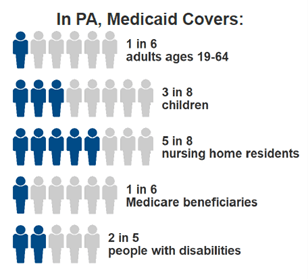 The loss of Federal funding to states would be devasting for the more than 3 million Pennsylvanians who are enrolled in Medicaid. Medicaid also pays for 30% of Medicare. Those that depend on its supports and services, include:

 Prev
Prev