






Project ECHO Announces Winter 2026 Virtual Sessions on Adult Neurodiverse Healthcare



Autistic and intellectually disabled people are at increased risk of being victimized and experiencing trauma; however, few therapists are skilled in both supporting these communities and providing trauma-focused care. To bridge this gap, psychologists with the ASERT team created the TRAIN program — 12 weeks of self-guided learning and live webinars for mental health therapists licensed in Pennsylvania who are currently working with autistic and/or intellectually disabled adults. TRAIN is an integrative and neuro-affirming approach to trauma-focused care with neurodivergent adults, centering clinical work with the autistic and intellectually disabled communities. After completing the 12 weeks of learning, participants have the option to continue their training through clinical consultation with the developers of TRAIN.
This program covers:
Target Audience: This program was developed for therapists, counselors, and clinical social workers who already have experience working with clients who have an Intellectual Disability/Autism (ID/A) diagnosis and are looking to gain knowledge and skills related to trauma therapy. Therapists who do not have experience with ID/A clients are also welcome to participate, but the expectation is they would be committed to taking such clients into their practice after completing the program, as the purpose is to build capacity in this area across the state. You must currently be licensed and provide 1:1 talk therapy sessions to adult clients at the moment to qualify for this course and participate in the case consultation presentations.
Course Structure: 12 weeks in total, comprised of 3 modules that are each 4 weeks long. The first three weeks are self-paced learning courses that are assigned through the online Learning Management System. The fourth week of each module is an hour-and-a-half interactive discussion with the other group members and instructors. These live sessions are required and are held from 9:00 am – 10:30 am on the following dates:
Case Consultations: After the initial 12 weeks, there is a short break followed by a second 12-week session that consists of weekly one-hour case consultations. These are optional but highly recommended. Each participant is expected to present a case from a current patient and receive feedback/information from other participants and the instructors. Participants need to join at least 6 of the 12 weekly case consultation calls, although it is encouraged to attend all of them. If you are not currently seeing patients or are not in the capacity to present any cases, this may not be the right program for you.
Cost and CE Credits: It is free to participate. 13.5 continuing Education (CE) credits are provided through the National Board for Certified Counselors (NBCC) upon completion of the program.
If you believe this program is appropriate for you and can commit to the requirements, please complete this survey by Wednesday, August 27, 2025. This will be on a first-come, first-serve basis, so don’t delay! Also, if you are unable participate this Fall due to other commitments but would still be interested in doing it for Spring 2026, please say so in the survey.


This Drexel University training will be held March 20, 2025, from 9:00 am – 3:30 pm, and will take place at the Holiday Inn Grantville. The training fee is $15 to attend and $45 for CEs/attendance. The course will be led by Chris Owens, MA, LPC, CCTP.
This course focuses on specific interventions of use to the professional helper when providing therapeutic services in behavioral healthcare. The aim of this workshop is to add to the helper’s “bag of tricks” or “toolkit” pertaining to assisting people with histories of trauma. Participants engage in didactic and experiential learning related to several specific interventions geared toward managing and moving beyond trauma. Participants also dialogue in small groups to share creative and effective interventions they have used in their various practice settings.
Learning Objectives:
By the end of this training, participants will be able to:
CE Credits:
Please visit here for additional information.

Join Drexel University Behavioral Healthcare Education’s visiting resident Radhika Rani, DO, for a special presentation titled “Mental Health Care for Migrants and Refugees in the U.S.: Culturally Informed Practices.”
Thursday, November 21, 2024
9:00 am – 12:15 pm ET
3 CE Hours
Live Webinar
This course aims to provide behavioral health professionals with the knowledge and skills needed to effectively address the mental health needs of migrant and refugee populations in the United States. Participants will explore the unique challenges and stressors encountered by these groups, including trauma, displacement, acculturation, and systemic barriers to care. Emphasis will be placed on culturally informed, trauma-sensitive approaches to diagnosis and treatment. In addition, the course will explore the legal, social, and policy implications impacting migrant and refugee communities as well as outline strategies for patient advocacy. Participants will also be able to gain practical skills while reflecting on personal biases and assumptions to foster more inclusive care and improve patient outcomes.
Register at the BHE website.

Insidious Trauma: Context, Impact, and Considerations for Care
Wednesday, September 11, 2024
10:00 am – 1:00 pm
Register Here
This session will introduce the impact of trauma broadly, provide an overview of insidious trauma and its effects, and explore some relevant interpersonal and clinical considerations in supporting those impacted by traumatic stress. Presenters will share their expertise on best and promising practices as well as provide general knowledge. View the announcement for more information.

Prescription, Addiction, and Prohibition: Our Love/Hate Affair With Opioids
January 9, 2024
9:00 am – 3:30 pm
Early bird rate: $35 (ends 1/2/24)
Regular rate: $45 (begins 1/3/24)
Location: Holiday Inn, Grantville, PA
Instructor: Karin C. Gladney, PhD, CAADC
CE Credits: 5 Hours
Register on the BHE Website
 This course is designed to provide an overview of the cycle of use and abuse of opiates in the United States. The diagnostic criteria for opioid use disorders, including clinical presentation, epidemiology and treatment, will be explored. Participants will learn about the mechanisms of action of opioids, including how they affect the brain and nervous system. In addition, the course will cover strategies for managing opioid overdose and preventing relapse, as well as the importance of addressing co-occurring mental health conditions in the treatment of opioid use disorder. Participants will gain the knowledge and skills necessary to effectively address opioid use disorders in their practice or community.
The Fundamentals: Trauma Definitions and Diagnoses
January 10, 2024
9:00 am – 3:30 pm
Early bird rate: $35 (ends 1/2/24)
Regular rate: $45 (begins 1/3/24)
Location: Holiday Inn, Grantville, PA
Instructor: Karin C. Gladney, PhD, CAADC
CE Credits: 5 Hours
Register on the BHE Website
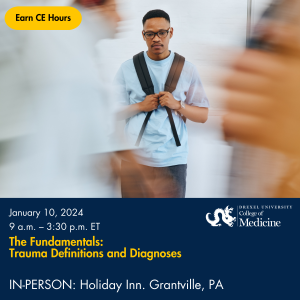 Trauma is ever-present in the lives of many people who seek professional help. This training will provide a foundational overview necessary to understand the impact of traumatic experiences. Areas that will be explored include definitions, diagnostic criteria, prevalence data and brain changes. Participants will engage in discussions regarding their professional experiences in working with people with trauma histories. A vignette will be provided highlighting the lasting impact trauma can have on a person, as well as the healing journey toward recovery. Lastly, the importance of becoming trauma-informed practitioners will also be introduced.
Project Echo at Penn State College of Medicine Presents:
Project Reassure: Fostering Resilience for Adult Neurodiverse Communities
Register for this no-cost training hour-eligible series for professionals serving adult neurodiverse individuals. The eight-session Project Reassure ECHO series will launch on January 12, 2024, from 7:45 am –9:00 am.
This series will provide participants with strategies in supporting adult neurodiverse individuals struggling with anxiety related to the COVID-19 pandemic and building resilience. The curriculum will cover the basics of recognizing trauma, stress, and anxiety; fostering resilience building skills; crisis prevention; dealing with uncertainty; and changes in the adult neurodiverse brain. Professionals serving adult neurodiverse individuals, including immediate direct clinical supervisors of direct support professionals, group home managers, behavior specialists, and program coordinators, are encouraged to register and actively participate.
Additional details and registration information can be found on the event flyer.
